|
|
|
| Australia and Japan Forge a 50-Year-Strong Strategic Partnership to Safeguard Regional Security and Prosperity |
** "Economic and energy security are inseparable from national resilience;
our partnership ensures stability for both nations." – Prime Minister
Anthony Albanese ***
"Australia and Japan are building a stronger
partnership to secure peace, prosperity, and resilience for our region."
– Prime Minister Sanae Takaichi
***
"By working together across
trade, defence, and technology, Australia and Japan are setting a global
standard for strategic cooperation." – Foreign Minister Penny Wong
|
Australia and Japan Forge a 50-Year-Strong Strategic Partnership to Safeguard Regional Security and Prosperity
5/05/2026
(See translation in Arabic section)
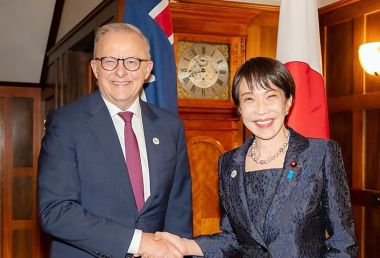
Sydney-Middle East Times Int'l: Australia and Japan have marked a historic milestone in their bilateral relationship with a series of agreements and initiatives aimed at strengthening economic security, energy resilience, critical minerals cooperation, defence capabilities, and cyber readiness. These announcements coincided with the 50th anniversary of the Basic Treaty of Friendship and Cooperation, signed in 1976, highlighting five decades of trust, shared values, and mutual prosperity. The milestone event, held at Parliament House in Canberra on 4 May 2026, brought together Prime Ministers Anthony Albanese and Sanae Takaichi in a celebration that combined formal agreements with personal camaraderie, reflecting both the depth and warmth of the bilateral relationship.
Strengthening Economic Security
At the core of the 2026 agreements is the Joint Declaration on Economic Security Cooperation, designed to ensure the resilience of supply chains for critical goods, including energy products, food, and strategic minerals. Both nations pledged to protect advanced technologies, coordinate responses to economic disruptions, and consult regularly on contingencies affecting their economic security. Prime Minister Albanese emphasized that in an era of global volatility, "economic and energy security are inseparable from national resilience," while Foreign Minister Penny Wong highlighted the "shared commitment to strategic alignment and mutual prosperity."
Japan remains a vital economic partner for Australia, being the third-largest two-way trading partner and second-largest export market, underscoring the importance of deepening economic ties. Trade Minister Don Farrell emphasized the mutual benefits of the agreements, noting that secure and resilient supply chains would bolster trade, protect consumers, and foster long-term prosperity for both nations.
Securing Energy Supplies
Energy security was a central theme of the leaders’ discussions, reflected in the Joint Statement on Energy Security. Australia and Japan agreed to safeguard the reliable flow of essential energy goods, including fuel, gas, refined petroleum, and diesel. Australia currently supplies roughly one-third of Japan’s energy needs, making it Japan’s largest LNG provider, while Japan provides Australia with refined petroleum and diesel.
The agreement also affirms a commitment to open, rules-based trade, designed to protect businesses and consumers from supply disruptions. Minister Bowen underscored that the partnership not only secures fuel for both nations but also acts as a buffer against global market volatility. The leaders emphasized that cooperation in energy trade is not just transactional but a strategic imperative that strengthens regional stability amid global uncertainties, such as disruptions in the Middle East or energy market shocks.
Critical Minerals Cooperation
Recognizing the growing importance of strategic resources, Australia and Japan have expanded their collaboration on critical minerals. Building on the 2022 Australia-Japan Critical Minerals Partnership, the two nations are now focused on onshore processing, refining, and advanced manufacturing. This initiative aims to secure supply chains, attract investment, and meet Japanese industry demand for minerals such as gallium, nickel, graphite, rare earths, and fluorite.
Australia is offering up to $1.3 billion in support through the Critical Minerals Facility and Export Finance Australia, including non-binding Letters of Support for strategic projects. The partnership is expected to generate jobs, enhance capabilities, and strengthen economic security for both nations. The collaborative approach ensures that critical minerals become a core pillar of the Australia-Japan economic and national security relationship, protecting both countries from potential supply chain disruptions.
Defence and Security Integration
In defence and security, the two nations have deepened cooperation to promote a peaceful, stable, and prosperous Indo-Pacific. This builds on a series of agreements, including the 2022 Joint Declaration on Security Cooperation, the Reciprocal Access Agreement (RAA) in 2023, and the Framework for Strategic Defence Cooperation (FSDC) in December 2023.
Key initiatives include military integration and interoperability, such as increased information sharing, joint exercises, and enhanced operational coordination. Defence industry collaboration is also being expanded, including co-development and co-production of advanced capabilities, with procurement projects like Mogami-class frigates strengthening joint naval capacity.
Deputy Prime Minister Richard Marles highlighted the significance of enhanced joint training and planning, framing the cooperation as a deterrence mechanism in a complex security environment. Both leaders underscored that such integration strengthens their capacity as middle powers working collaboratively to uphold peace and stability in the Indo-Pacific region.
Strategic Cyber Partnership
Recognizing the growing threat of cyber attacks, Australia and Japan have launched a Strategic Cyber Partnership, designed to improve regional cyber resilience and safeguard critical technologies. The partnership emphasizes collective cyber defence, collaboration on critical technologies, regional resilience through public-private initiatives, and coordination on contingencies affecting sovereignty or regional security.
PM Albanese stressed that “cybersecurity is as vital as physical borders,” while Minister Tony Burke noted that no single nation can counter cyber threats alone. This partnership reflects a forward-looking approach to security, recognizing that technological vulnerabilities are just as critical as traditional military concerns.
Leadership and People-to-People Initiatives
To strengthen dialogue across sectors, the Australia-Japan Leadership Dialogue was established as a “1.5 track” initiative connecting government, academia, business, and civil society. The dialogue fosters practical cooperation, creates networks for emerging and established leaders, and serves as a platform for innovation and joint problem-solving.
People-to-people ties have also flourished, with record-high travel between the countries in 2025 and robust educational and cultural exchanges. Both leaders emphasized that societal connections are integral to sustaining the strategic partnership, complementing formal agreements with trust and mutual understanding.
A Vision for the Indo-Pacific
Throughout the meetings, Prime Ministers Albanese and Takaichi stressed their shared vision for a free and open Indo-Pacific (FOIP). Discussions covered regional security challenges, including North Korea’s nuclear and missile programs, China’s regional influence, and broader geopolitical uncertainties. Both nations reaffirmed their commitment to collaborative engagement with the United States, The Quad, and like-minded partners, ensuring regional stability while promoting trade, innovation, and security.
In commemorating 50 years of friendship and cooperation, Australia and Japan have not only celebrated past achievements but also set a roadmap for the next 50 years, encompassing economic resilience, energy security, defence cooperation, technological advancement, and people-to-people engagement. Their strategic partnership stands as a model of how middle powers can work collaboratively to address global challenges while safeguarding regional prosperity.
|
|
|
|
|
|