|
|
|
| Piece of Opinion: The Middle East: Between Postponed Peace and Open War |
|
The Middle East: Between Postponed Peace and Open War
By: MET
9/07/2026
Sydney – See Translations in Arabic Section: Agreements have multiplied, rounds of negotiations have been numerous, and meetings have moved from one capital to another, but practical results have remained absent, limited, or incapable of stemming the bloodshed. Each time a new framework or understanding is announced, hopes rise slightly, only to be quickly dashed by the reality on the ground: an ongoing occupation, relentless attacks, demolished homes, and the ceaseless flow of blood in southern Lebanon.
This raises the fundamental question: What is the point of new negotiations between Lebanon and Israel if Israel has not adhered to the framework agreement, continues to occupy areas in southern Lebanon, and persists in its military operations under the guise of security and self-defense? Can any negotiation be serious when the balance of power on the ground dictates its own terms, and the lives of civilians remain suspended between a fragile truce and a sudden escalation?
In this equation, Lebanon is not merely a small geographical area on the map of the Middle East. It is a precise mirror of the region's power balances and a sensitive indicator of the nature of the larger conflict between the United States and its allies on one side, and Iran and its allies on the other. Every tremor in the US-Iranian relationship immediately reverberates in Lebanon, as well as in the Gulf, Iraq, Syria, and Yemen. When diplomacy breaks down between Washington and Tehran, the language of missiles prevails, and small states become testing grounds for power and messages.
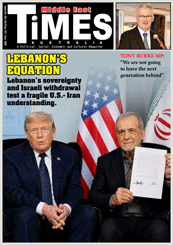
Concerns have intensified with the renewed exchange of fire and escalation between the US and Iran, following US President Donald Trump's declaration that the memorandum of understanding related to the ceasefire with Iran was "terminated," according to media reports published on July 8, 2026. Other reports spoke of renewed strikes and retaliatory attacks, and of heightened tensions in the Gulf and the Strait of Hormuz, threatening energy security and international navigation.
In this context, Lebanese-Israeli negotiations, regardless of their specific focus, appear incapable of producing a lasting peace on their own unless they are part of a broader regional settlement. The problem is no longer limited to border demarcation, withdrawal from occupied territories, or a temporary ceasefire. The problem runs deeper: it touches on the future of regional influence, the fate of weapons outside state control, security guarantees for Israel, Lebanon's right to full sovereignty, Gulf security, the Iranian nuclear program, and the American military presence in the region.
Therefore, many experts and observers believe that a genuine solution cannot emerge from partial negotiations or temporary truces, but rather from a comprehensive understanding between the United States and its allies and Iran and its allies, based on clear principles: ending proxy wars, respecting state sovereignty, protecting civilians, controlling weapons, ensuring maritime and energy security, and opening the door to a comprehensive peace that includes Lebanon, the Gulf Arab states, and Israel within a new regional vision.
Continuing the policy of "crisis management" instead of resolving it will only prolong the war in different forms. The fronts may quiet down for days or weeks, but they will reignite as long as the roots of the conflict remain unaddressed. A truce without guarantees is not peace, negotiations under fire are not a settlement, and an agreement that is not implemented does not build trust. The most dangerous aspect is that the region today faces only two options: either political courage leading to a comprehensive peace, or a prolonged slide into open warfare that could last for years. Some predictions go even further, warning that continued escalation in the Middle East, if it intersects with the interests of major powers, could open the door to a wider international confrontation, and perhaps even a third world war.
This prospect may seem grim, but it is not impossible in a world that has lost much of its restraint. Therefore, what is needed is no longer yet another agreement to add to the archive of failed ones, but rather a courageous international and regional decision to halt the collapse before war becomes an unstoppable reality. (MET)
|
|
|
|
|
|