| A Lebanese Statement Challenges The Regional Bargain |
** The statement issued by Lebanese public figures contradicts this. It
argues that Iranian intervention constitutes interference in sovereign
affairs and that Lebanon must negotiate on its own.
|
A Lebanese Statement Challenges The Regional Bargain
25/06/2026
(See translation in Arabic section)
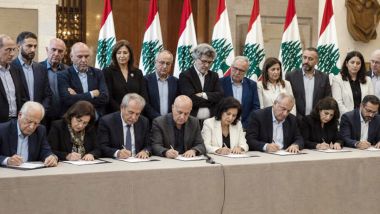
Sydney-Middle East Times Int'l: The public statement by more than 400 Lebanese figures is significant because it pushes back against two pressures at once.
On one side, Israel remains militarily present in southern Lebanon and is demanding security guarantees against Hezbollah. On the other, Iran and Hezbollah are trying to shape the post-war settlement through the wider U.S.-Iran framework.
The Lebanese signatories are saying that Lebanon should not be treated as a bargaining chip.
They support direct negotiations with Israel to achieve a durable end to hostilities and secure full Israeli withdrawal from Lebanese territory. At the same time, they condemn Iranian interference and call for the state to regain the exclusive monopoly over legitimate armed force by disarming Hezbollah.
That combination is politically explosive.
It rejects Israeli occupation, but also rejects Hezbollah’s claim to decide war and peace for Lebanon.
The Signatories Are Targeting Hezbollah’s Core Argument
Hezbollah’s argument is that its weapons remain necessary because Israel occupies Lebanese land and threatens Lebanon.
The public figures backing direct talks challenge that logic. They argue that Lebanese sovereignty requires two things at once: Israeli withdrawal from the south and Hezbollah’s disarmament under state authority.
That is a direct challenge to Hezbollah’s political identity.
For decades, Hezbollah has framed its weapons as resistance. The statement reframes those weapons as an obstacle to sovereignty. It says Lebanon cannot fully recover state authority while an armed party maintains a military structure outside government control.
This is why the intervention matters beyond the number of names attached to it.
It changes the question from “Should Lebanon negotiate with Israel?” to “Who has the right to decide Lebanon’s future?”
Independent Shiite Support Carries Special Weight
The inclusion of independent Shiite figures is especially important.
Hezbollah presents itself as the dominant defender of Lebanon’s Shiite community. Criticism from Christian parties, Sunni politicians, or secular activists can be dismissed by Hezbollah as hostile or aligned with foreign pressure. Independent Shiite voices are harder to dismiss in the same way.
Their participation suggests that the debate over Hezbollah’s weapons is not simply sectarian.
It is also about state authority, war fatigue, displacement, economic collapse, and whether Lebanon’s communities can survive another round of regional confrontation.
That does not mean Hezbollah has lost its base.
It means the political space around its arms is being contested more openly.
Washington Talks Are Moving Without Hezbollah
The statement comes as Israel and Lebanon resume direct negotiations in Washington.
Those talks are being held while Hezbollah refuses to participate and condemns the process as capitulation to U.S. and Israeli demands. Lebanon’s government is trying to regain control of the ceasefire process and restore its sovereignty while avoiding the appearance that Iran or Hezbollah is negotiating on behalf of the state.
That is the central diplomatic contradiction.
The talks involve Israel and Lebanon, but the armed force at the center of Israel’s security concerns is outside the room. Any agreement will have to deal with Hezbollah even if Hezbollah is not formally present.
This is why the statement by Lebanese public figures matters.
It gives political cover to the idea that direct talks are not surrender if they are aimed at withdrawal, sovereignty, and state control.
Iran’s Role Has Become A Lebanese Political Problem
The U.S.-Iran memorandum has brought Lebanon directly into a wider regional bargain.
Iran has used pressure over the Strait of Hormuz and the ceasefire file to claim influence over the Lebanese track. Hezbollah’s leader has urged Lebanese authorities to use the U.S.-Iran agreement as leverage, saying Iran “closed the Strait of Hormuz for Lebanon.”
That message is meant to show that Hezbollah’s alliance with Tehran gives Lebanon leverage.
The Lebanese public figures’ statement says the opposite.
It argues that Iranian involvement is interference in sovereign affairs and that Lebanon must negotiate for itself. That puts the Lebanese state and Hezbollah’s regional strategy on a collision course.
Israeli Withdrawal And Hezbollah Disarmament Are Linked
The statement does not support direct talks with Israel as a stand-alone gesture.
It ties talks to a broader settlement: ending hostilities, securing Israeli withdrawal, and restoring the Lebanese state’s control over weapons. This linkage is crucial because each side is using the other issue as justification.
Israel says it needs a security zone because Hezbollah remains armed.
Hezbollah says it needs weapons because Israel remains in Lebanon.
Lebanese public figures are trying to break that loop by demanding both outcomes: Israel out, Hezbollah disarmed, state authority restored. |