|
|
|
| ALCC leaders sound alarm on housing and economic pressures |
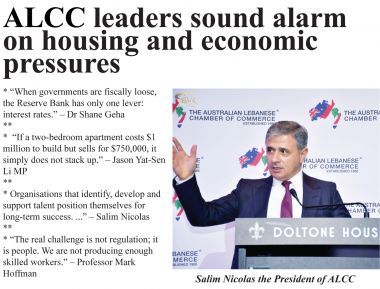
** Organisations that identify, develop and support talent position themselves for long-term success. ...” Salim Nicolas
|
ALCC leaders sound alarm on housing and economic pressures
* “When governments are fiscally loose, the Reserve Bank has only one lever: interest rates.” – Dr Shane Geha
***
* “If a two-bedroom apartment costs $1 million to build but sells for $750,000, it simply does not stack up.” – Jason Yat-Sen Li MP
***
* Organisations that identify, develop and support talent position themselves for long-term success. ...” – Salim Nicolas
***
* “The real challenge is not regulation; it is people. We are not producing enough skilled workers.” – Professor Mark Hoffman
26/05/2026
Sydney-Middle East Times Int'l: Business leaders, policymakers and industry experts gathered to examine the impact of global instability on the local economy at a Australian Lebanese Chamber of Commerce (ALCC) business luncheon in Sydney. Through a combination of keynote remarks and an extended panel discussion, the event explored how geopolitical uncertainty, inflationary pressures, policy decisions and structural constraints are shaping economic outcomes in Australia, particularly in relation to housing affordability, workforce shortages and long-term economic resilience. The following is an edited account of speeches from the Master of Ceremonies, the ALCC President and key participants, along with a question-and-answer session featuring Dr Shane Geha, economist and business adviser; Professor Mark Hoffman, construction and engineering academic; and Hon. Jason Yat-Sen Li MP, NSW Member for Strathfield, providing an overview of the event’s main themes and discussions.
Paul Nicolaou, the MC
The business luncheon was opened by Mr Paul Nicolaou, Master of Ceremonies and business leader, who welcomed guests and highlighted the growing importance of the ALCC as a platform for dialogue and engagement.
He noted that the Chamber is highly respected for its networking opportunities, quality events, and the calibre of its speakers. “Today, we are fortunate to have an outstanding panel sharing insights into global economic uncertainty and its local implications,” he said.
Mr Nicolaou emphasized that such events foster connections across industries, encourage meaningful discussions, and build lasting relationships. He also highlighted the ALCC’s role in strengthening ties between the Australian and Lebanese business communities and fostering a strong sense of shared purpose, especially in times of uncertainty.
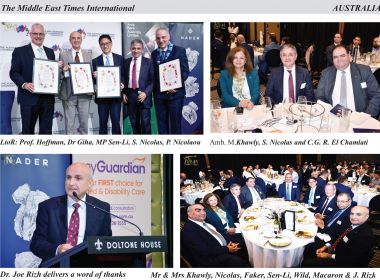
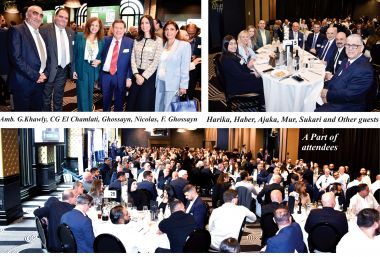
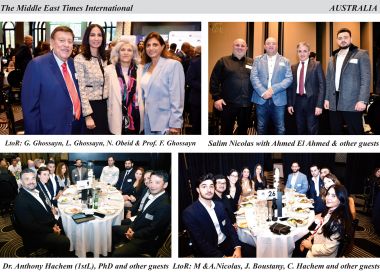
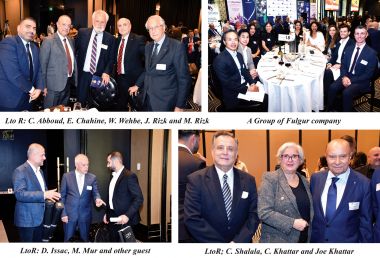
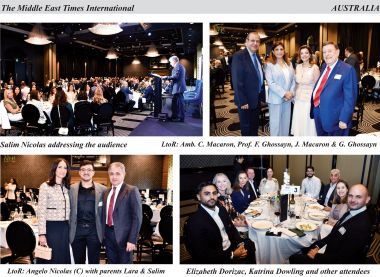
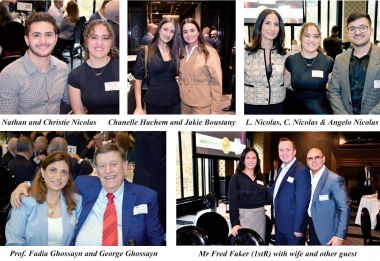
The event brought together a wide range of distinguished guests, including ALCC President Salim Nicolas OAM and his wife Lara Nicolas; Her Excellency Mirna Khawly, Ambassador of Lebanon; former Ambassador His Excellency Mr Ghassan Ali Khawly; His Excellency the Consul General Raymond El Chamlati; His Excellency Ambassador Mr Charbel Macaron; the State Member for Strathfield, Hon. Jason Yat-Sen Li MP; the Honourable John Ajaka, former President of the NSW Legislative Council; the Mayor of Burwood, Councillor John Faker; Deputy Mayor of Canterbury-Bankstown, Councillor Rachelle Harika; Dr Joe Rizk OAM, CEO of Arab Bank Australia; along with a large number of business leaders, professionals, academics and members of the ALCC Young Professionals network.
The diversity of the audience reflected the cross-sector importance of the issues being discussed and contributed to a conversation that combined practical experience with broader policy insight.
ALCC President Salim Nicolas OAM, business leader and community advocate
Mr Nicolas opened his address by acknowledging the uncertainty that currently characterises global economic conditions, while emphasising the importance of focusing on areas within organisational control.
“We may not be able to influence the global economy directly,” he said, “but we can take steps to prepare for it and respond effectively.”
He argued that one of the most important of these steps is investment in human capital.
“Central to stability and growth is the investment we make in our people. Without that investment, no organisation can sustain long-term success.”
Mr Nicolas elaborated on the importance of developing talent, particularly among younger professionals.
“We must continue to nurture graduates and new team members,” he said. “They bring fresh perspectives, new ideas and a willingness to challenge established approaches. These qualities are not optional; they are essential.”
He stressed that organisations must adopt a long-term mindset when it comes to talent development.
“It is not enough to recruit skilled individuals. We must provide them with opportunities to grow, to contribute and to develop their capabilities over time. That requires commitment and consistency,” Mr Nicolas said.
To illustrate his point, Mr Nicolas drew on both historical and cultural examples.
“The Eiffel Tower is often associated with Gustave Eiffel, but the contributions of engineers such as Émile Nouguier and Maurice Koechlin were integral to its success. Their abilities were cultivated over many years, and without that investment, the project would not have been possible.”
He then moved to an example from the arts.
“In music, Michel Vaucaire and Charles Dumont played a pivotal role in reviving the career of Édith Piaf with the song Non, je ne regrette rien. At a time when her career had stalled, their work provided a catalyst for renewal and success.”
These examples, Mr Nicolas suggested, reflect a broader principle.
“Organisations that identify, develop and support talent position themselves for long-term success. Those that fail to do so risk decline.”
He warned that complacency can be particularly dangerous.
“We have seen organisations that were once dominant fall into decline because they stopped adapting. They became comfortable with their position and lost the ability to respond to change,” Mr Nicolas said.
Turning to the future of the Chamber, Mr Nicolas announced the launch of the ALCC Young Professionals initiative.
“This program represents a commitment to the next generation,” he said. “It provides a platform for young professionals to connect, learn and contribute in meaningful ways.”
He noted that engagement from younger members has already been strong.
“There is real enthusiasm among our younger members. They want to be involved, they want to contribute and they want to grow.”
To support this initiative, Mr Nicolas announced that new members under 30 would be offered free membership until June 2028.
“This is about removing barriers and creating opportunities. It is an investment in our future,” he said.
He concluded by emphasising the role of mentorship.
“As experienced professionals, we have a responsibility to guide and support those who come after us. By sharing our knowledge, we strengthen not only individuals, but the broader community.”
Q&A: Global Uncertainty, Housing, and Economic Pressures
The panel discussion that followed brought together three distinct perspectives—policy, academic and business—offering a comprehensive view of the economic challenges currently facing Australia.
On economic uncertainty
Dr Shane Geha, economist and business adviser, opened the discussion by placing current economic conditions in a broader historical context.
“There have certainly been more uncertain times,” Dr Geha said. “The early 1990s recession, for example, was characterised by extremely high interest rates, significant inflation and widespread economic stress.”
He described how multiple global and domestic factors contributed to that period.
“We were dealing with geopolitical tensions, volatility in energy markets and major structural changes across economies. These factors combined to create a very challenging environment.”
Dr Geha noted that while today’s conditions are complex, they are not without precedent.
“What is important is how we respond. History shows that resilience and adaptability are critical.”
He emphasised the role of fiscal policy in shaping current economic outcomes.
“When governments are fiscally loose, inflationary pressures build. At that point, central banks have limited tools available, and interest rates become the primary mechanism for managing inflation.”
He explained the impact of this on households.
“Those who have taken on significant levels of debt, particularly mortgage holders, are the most affected. Changes in interest rates translate directly into financial pressure.”
Dr Geha also highlighted the role of confidence in economic performance.
“Economic outcomes are not just determined by policy settings or financial indicators. They are influenced by behaviour—by how individuals and businesses perceive risk and opportunity.”
He noted that declining confidence can have a compounding effect.
“When confidence weakens, people become more cautious. They spend less, invest less and delay decisions. That can lead to a slowdown in economic activity.”
He added that communication plays a critical role.
“Clear messaging from governments and institutions can help stabilise expectations, while uncertainty can have the opposite effect.”
At the same time, Dr Geha stressed the importance of adaptability.
“The organisations that succeed are those that are able to respond quickly. They recognise changes in the environment and adjust their strategies accordingly.”
He concluded by emphasising that even in difficult conditions, opportunities exist.
“In every cycle, there are opportunities. The challenge is recognising and acting on them when uncertainty is high.”
On construction and workforce constraints
Professor Mark Hoffman, construction and engineering academic, turned the discussion towards structural issues within the construction sector.
“The challenges we are seeing today did not emerge overnight,” Professor Hoffman said. “They are the result of long-term pressures on the system.”
He referred to high-profile failures as indicators of deeper issues.
“Events such as Opal Tower highlighted weaknesses in oversight and coordination. They prompted necessary reforms, but they also revealed the complexity of the system.”
Professor Hoffman acknowledged that regulatory changes have improved accountability.
“Compliance has increased, and that has brought greater clarity in many respects.”
However, he cautioned that increased compliance also brings increased cost.
“Every additional requirement adds time and expense. These costs accumulate and are ultimately reflected in the price of construction.”
He stressed that regulation alone cannot resolve systemic issues.
“The real challenge is not regulation; it is people.”
Professor Hoffman highlighted a shortage of skilled professionals.
“There are not enough engineers, tradespeople and technical specialists entering the workforce to meet demand.”
He explained that this shortage is linked to structural issues in education.
“The current pathways into these professions are not sufficiently flexible. They do not accommodate different backgrounds or life circumstances.”
He warned that this limits participation.
“As a result, we are drawing from a narrower talent pool than we should be.”
He emphasised the long-term implications.
“If this issue is not addressed, it will continue to constrain growth, particularly in sectors such as construction that rely heavily on skilled labour.”
On housing affordability
Hon. Jason Yat-Sen Li MP, NSW Member for Strathfield, described housing affordability as one of the most pressing challenges facing the state and the country.
“In New South Wales, the cost of housing has reached levels that make entry into the market extremely difficult, particularly for younger people,” Mr Li said.
He noted that the issue is complex and multi-layered.
“It is not simply a matter of supply and demand. It involves planning, financing, construction costs, infrastructure and community expectations.”
Mr Li provided a clear example of the economic challenge.
“If it costs $1 million to build a two-bedroom apartment and it sells for $750,000, the project is not viable. It will not proceed.”
He emphasised that viability is a fundamental constraint.
“Developers cannot operate at a loss. If the numbers do not work, the project does not move forward.”
He also highlighted the impact of delays.
“When projects take years to complete due to approvals and regulatory processes, supply cannot respond effectively to demand.”
Mr Li acknowledged that policy solutions take time to produce results.
“Housing is not something that can be fixed overnight. It requires long-term, consistent policy effort.”
Final reflections
The panel agreed that while global uncertainty remains an important factor, the most immediate challenges are domestic.
Housing affordability, workforce shortages and structural inefficiencies were identified as key areas requiring attention. At the same time, speakers noted that Australia retains strong economic fundamentals, including institutional stability and a history of resilience. However, they cautioned that these strengths should not lead to complacency.
“Maintaining these strengths requires ongoing effort and adaptation,” one speaker observed.
Word of Thanks
Dr Joe Rizk OAM, CEO of Arab Bank Australia and banking sector leader
Dr Rizk concluded the event by thanking organisers, speakers and attendees for their contributions. Reflecting on his career, Dr Rizk emphasised the cyclical nature of economic conditions.
“We have seen many cycles over the years, both positive and negative. What matters is how we respond.”
He highlighted resilience as a defining characteristic. “Those who succeed are those who are able to adapt, to recognise opportunity and to act decisively.”
He emphasised the importance of community. “Collaboration and shared purpose make a difference. When we work together, we achieve better outcomes,” Dr Rizk said. |
|
|
|
|
|