|
|
|
| Lebanon at the crossroads: Outspoken academic expresses a nation’s cry for sovereignty |
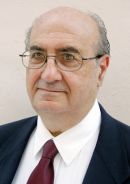
Dr Saleh El Machnouk ** “Five million Lebanese are being treated as pawns in a regional power struggle.” -- Dr Saleh El Machnouk
**
“When militias control weapons, Lebanon pays the price in blood and destruction.” -- Dr Saleh El Machnouk
**
“We are not a battlefield for regional ambitions; we are a nation that wants to live.” --Dr Saleh El Machnouk
|
Lebanon at the crossroads: Outspoken academic expresses a nation’s cry for sovereignty
29/03/2026
(See translation in Arabic section)
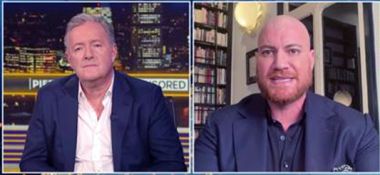
Sydney-Middle East Times Int'l: As Middle East warfare escalates, Lebanon is once again being drawn into a conflict not of its choosing. Since early March, Israeli strikes have killed more than 1000 people in Lebanon, injured thousands, and displaced over a million civilians, according to Lebanese health authorities, as fighting with Hezbollah and wider regional tensions involving Iran intensify. Speaking on Piers Morgan Uncensored on March 25, Lebanese academic Dr Saleh El Machnouk gave a blunt account of a country exhausted by war.
Dr Saleh El Machnouk, a professor at Université Saint Joseph in Beirut, has delivered a powerful and heartfelt message that Lebanon’s people reject militias, proxy wars, and moral lectures, and simply want sovereignty, safety, and the right to live.
“This is not Lebanon’s war, and it never was,” El Machnouk told prominent British broadcaster Piers Morgan, cutting through the geopolitical rhetoric that often surrounds the country. “For 57 years, Lebanon has been dragged into conflicts against the will of its own people.”
El Machnouk appeared to emphasise an often-ignored issue in global debate: ordinary Lebanese civilians are sidelined, their human suffering overlooked as external powers shape Lebanon's fate.
“What’s getting lost in the last three weeks,” he told Morgan, “is what has been happening in Lebanon. Five million of us are treated either as data, by people counting casualties, or as the natural consequence of someone else’s ideological war.”
Drawing on personal experience, El Machnouk emphasised the generational toll of conflict. “I am 42 now. This is the sixth war in my lifetime,” he said. “So, what I want to say, using your platform, is that we are officially and irrevocably done with our land being used for proxy wars.”
He underscored that his position was widely shared: “When I say ‘we’, I speak not just for myself, but for millions of Lebanese, an overwhelming majority, who refuse to be drawn into this conflict.”
To support his argument, El Machnouk cited polling data conducted by Gallup in Lebanon. According to the poll, 79 per cent of Lebanese respondents believe the Lebanese army should be the only body permitted to bear arms, while just 19 per cent oppose that position. More strikingly, when asked whether Lebanon should engage in military conflict with Israel in support of other regional causes, 86 per cent said no.
“Our message today is very clear to the world,” he said. “This is not our war.”
El Machnouk categorically dismissed the crisis as a war between Lebanon and Israel. He insisted, “This is not a war between Lebanon and Israel. There is no war between the Lebanese state and Israel. This is a proxy war fought by the IRGC and its proxy Hezbollah on Lebanese soil.”
In his account, Lebanon’s role is neither that of a strategic partner nor an ideological stakeholder, but that of a hostage. “We are all five million of us pawns and hostages, for the millionth time, in this regional equation,” he said.
The academic criticised moralising commentary from abroad: “We hear constantly from the West, lectures about resistance and aggression,” he said. “When Hezbollah fired rockets on March 2, Iran sent them a thank you letter for entering a war, despite ‘local obstacles’—the Lebanese people.”
Lebanese civilians, he argued, received nothing but devastation. “What did we get?” he asked. “Over a million displaced, more than a thousand dead, homes destroyed all over the country, billions of dollars in losses.”
El Machnouk levelled strong criticism at Western political and media ideologues, accusing them of romanticising violence while remaining detached from its consequences.
** “Not only bombs; we get lectures,” he said. “Pundits and intellectuals in the West use our suffering for their ideological fantasies.”
His language sharpened as the interview progressed. “How many Lebanese must die to satisfy your ideological cravings?” he asked directly, addressing figures who commented regularly on Lebanon from thousands of kilometres away. “How many? These people pontificate as if we’re children incapable of
deciding our own fate,” he added. “Khalas: enough. Leave us alone.”
He argued that ideological extremes feed each other, crushing moderation and civilian interests. “These ideologues are the natural allies of the worst elements of Israeli society,” he said. “Since the 1990s, Hezbollah and Israel’s extreme right have fought at this region’s and especially Lebanon’s expense.”
At the heart of El Machnouk’s argument was a rejection of armed groups operating outside the authority of the state. “When militias control weapons, Lebanon pays the price in blood and destruction,” he said. “The Lebanese people want one thing: a state that holds the monopoly on arms.”
He dismissed calls for the Lebanese army to align itself with Hezbollah against Israel as “idiotic” and “shameful”. “This is not only shameful, but it is also counterproductive,” he said. “And unlike them, I rely on facts, research, and history to prove my point.”
What followed was one of the most detailed segments of the interview, as El Machnouk laid out a historical comparison aimed at dismantling the claim that armed ‘resistance’ has protected Lebanon. Referring to the period between the 1949 armistice and 1969, when militias were largely absent from southern Lebanon, El Machnouk explained that Israel violated Lebanese sovereignty 82 times over 20 years. “Do you know how many Lebanese people died in that period?” he asked. “Fifteen.”
“In 20 years, 16 people were injured,” he continued. “Why? Because there were no militias in South Lebanon, and the state held the monopoly of arms.” By contrast, he said, the period from 2006 to 2026, often portrayed by supporters of Hezbollah as an era of effective resistance, tells a far darker story. “In that comparable period, 6152 Lebanese died, and 2356 were injured. Israeli violations of Lebanese sovereignty reached 62,150.”
“That is a 410 fold increase in deaths,” he said, “and a 756 fold increase in violations. The maths is clear.”
El Machnouk also challenged claims of Israeli expansionism in Lebanon, citing historical and legal facts he said are routinely ignored. “By certification of the UN Secretary General in April 2000, Israel exited every single inch of Lebanese territory,” he noted.
He contrasted this with the present: “Today, because of these so called wars of liberation, about 25 per cent of our territory is no longer under state control.” His conclusion was clear. “We know our history. We don’t need ideologues telling us to support an illegal sectarian militia. We must stand with our army, restore Lebanese sovereignty, and let our people live.”
Toward the end of the interview, Piers Morgan pressed El Machnouk on whether action against Iran might ultimately benefit Lebanon. El Machnouk responded cautiously, distinguishing between analytical judgment and national interest. “As an analyst, I would say yes, the region has seen nothing from the IRGC except assassinations, radicalisation, and endless war,” he said. “But my main concern is not supporting or opposing a war on Iran. My concern is Lebanon.”
He ended with a deeply personal appeal, delivered in a mix of English and Arabic. “We are not a battlefield for regional ambitions,” he said. “We are a nation that wants to live.” |
|
|
|
|
|