 | “Attacks on mosques should not be taken lightly, as threatening the safety of worshippers represents...”
| | |  | “I finally ate normally and felt better every day,” – Elissar Nakouzi, crediting Brother Estephan Nehme.
| | |  | “The new footbridge makes it safer and easier for our community to connect and enjoy the park.” — Cr Martin Zaiter
| | | .jpg) | Bibi Netanyahu, You Stand Guilty
| | |  | St. Rita Feast Day Mass Berrima
| | |  | “Social cohesion cannot be used as a justification to silence disagreement,” Dr Jneid said.
| | |  | For the attention of the Maronite leaderships!
| | |  | “Patriarch Estephan Doueihi: A Saint of Unity, Faith, and Lebanon’s Enduring Spirit”
| | |  | "Matters should be dealt with in the courts, not in political speeches or indefinite detention...".
| | |  | Statement from Major General Ashraf Rifi – Attacking religious authorities is a red line!
| | | 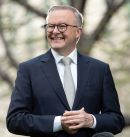 | "In times of tragedy, we find strength in unity, and from that strength, progress is born." – Prime Minister Anthony Albanese
| | |  | An Unanswered Question
| | | |
|
|
| Prime Minister Anthony Albanese promotes Australia as a leading force in International affairs |
** Quotes
“Australia and the United States are great partners. I expect
our meeting to be very constructive.” – Prime Minister Anthony Albanese ** “Our whole policy setting is about a welcoming, stable, warm policy
environment for investors who help us reduce emissions and reduce
bills.” – Energy Minister Chris Bowen
|
Prime Minister Anthony Albanese promotes Australia as a leading force in International affairs
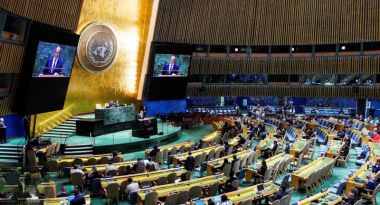
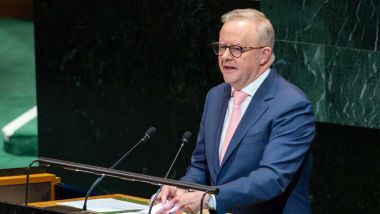
Prime Minister Anthony Albanese - United Nations General Assembly Hall
New York – 24 September 2025
(See translation in Arabic section)
Sydney-Middle East Times Int'l: Eighty years ago, the world emerged from devastation and built a framework for peace. The United Nations was founded on rights, rules, and respect for sovereignty, ensuring the dignity and equality of all people. Its endurance rests not on the power of a few but on the shared commitment of all nations.
Australia reaffirms that peace is both a common cause and a collective responsibility. The post-war leadership of the United States laid the foundations for stability in our region, but no single nation can guarantee security alone. All states, large and small, must uphold the rules-based order.
For Australia, this means strengthening capabilities, deepening relationships, and investing in development, defence and diplomacy. We support unity through the Pacific Islands Forum, deepen engagement with ASEAN, and elevate ties with Indonesia, India, Korea and Japan. We also expand partnerships with the UK, the EU and our principal ally, the US. Mutual understanding, prosperity and cooperation remain the strongest counterweights to conflict.
Australia recognises that prosperity and security abroad must connect with our people at home. Our engagement through the G20, APEC and the Quad is about fulfilling, not compromising, our national interests. The UN is a forum where small and middle powers can shape global aspirations. That is why Australia seeks a seat on the Security Council in 2029–30 and will co-host COP31 with Pacific partners, for whom climate change is an existential threat.
Today, challenges are varied and urgent: dictators repressing their own people, tyrants invading sovereign nations, regimes undermining democracy with technology, and terrorism threatening global stability. Australia has seen this danger firsthand, with Iran orchestrating attacks against Jewish communities in Melbourne and Sydney. We expelled the Iranian Ambassador, the first such step since WWII, and declared firmly: there is no place for antisemitism.
Australia does not impose its values but brings them to the world. We helped draft the UN Charter and joined its first peacekeeping mission in Indonesia. We champion free and fair trade while insisting workers share in its prosperity, and we uphold maritime and communications security through the UN Convention on the Law of the Sea, including in the South China Sea.
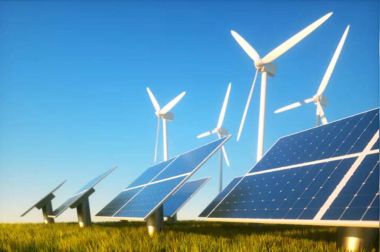
On climate action, Australia embraces renewable energy to meet ambitious targets: 43% emissions cut by 2030 and 62–70% by 2035. Clean energy enables Indo-Pacific nations to industrialise while decarbonising, ensuring both growth and responsibility.
As one of the world’s oldest democracies and among the first to extend suffrage to women, Australia continues Jessie Street’s legacy of ensuring women’s voices are heard in global governance. We promote education, opportunity, and empowerment for women and girls worldwide. We honour Indigenous knowledge, reject discrimination in all forms, and protect humanitarian workers. This week, Australia launched the Declaration for the Protection of Humanitarian Personnel, already been endorsed by more than 100 nations.
We stand with Ukraine in resisting Russia’s illegal invasion, supporting peace on Ukraine’s terms. Global security depends on sovereignty and the principle that no nation is above the rules.
The UN must remain an engine of action, not just ideals. Its worth is measured in lives saved, poverty reduced, and futures secured. Reform is needed, but the mission endures: to deliver food to the hungry, vaccines to the vulnerable, clean water to the needy, and freedom to those oppressed.
Nowhere is this more urgent than in the Middle East. Australia calls for a ceasefire, the immediate release of hostages, humanitarian aid for those in need, and no role for Hamas in Gaza’s future. This week, Australia recognised the State of Palestine, affirming the Charter’s ideals: to save future generations from war, uphold human rights, and practice tolerance in peace. History and principle demand that these words apply here, now.
Australia also honours our Pacific neighbour, Papua New Guinea, celebrating 50 years of independence. Soon, PNG will become our newest ally, proof that times change but shared ideals endure.
More than ever, humanity must choose cooperation over conflict, progress over paralysis. More than ever, nations must prove that the promises of the UN deliver real results. Australia, true to our history, will always play our part.
Invest in a Future Made in Australia
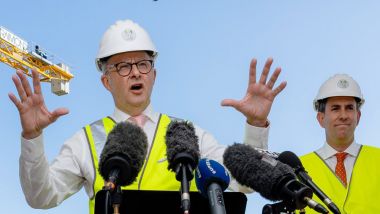
Prime Minister Anthony Albanese at Macquarie Bank, New York
Tuesday, 23 September 2025
Australia’s economic story has long been defined by resilience, innovation, and global engagement. From its resources to its institutions, the nation has built trust as a reliable trading partner. Today, with the world in transition to clean energy and secure supply chains, Australia seeks to move beyond its traditional role as a supplier of raw materials to become a hub for advanced manufacturing, renewable technology, and research.
This was the message Prime Minister Anthony Albanese delivered in New York, addressing an audience hosted by Macquarie Group alongside Ambassador Kevin Rudd and Consul-General Heather Ridout. The speech outlined how Australia can partner with American capital to shape the next phase of global growth.
A History of Shared Innovation
Australia’s ties with the United States extend well beyond defence. For decades, “American markets have provided the proving ground for Australian innovators, researchers, and creatives.” Success in the U.S. has often translated to global success, while American companies have expanded in Australia, creating jobs and driving technology.
Global firms such as Google, Microsoft, Amazon, Pfizer, Chevron, Exxon, Lockheed Martin and Anduril, alongside major U.S. investment funds, all have significant operations in Australia. Albanese argued the time is right to take this partnership to the next level.
Clean Energy: The Defining Transformation
Albanese described the global clean energy shift as the most profound transformation since the Industrial Revolution. The critical question is where the investment and manufacturing base will be located. He argued strongly that the answer is Australia.
With vast reserves of lithium, zinc, nickel, and rare earths, unmatched solar potential, and space for integrated supply chains, Australia is well-positioned to supply both the resources and renewable power future industries require. He framed this as not just an environmental imperative but a strategic opportunity: advanced manufacturing driven by clean energy can become a new source of national advantage.
Aligning Competitiveness and Security
The government sees rising energy and transport costs as key to future competitiveness, even more than labour costs. By aligning economic policy with national security, Australia aims to secure supply chains while boosting high-value manufacturing.
Australia also offers a skilled workforce, advanced research capacity, and deep financial reserves. The compulsory superannuation system, projected to direct more than $1 trillion into the U.S. economy by 2035, is already funding major Australian infrastructure and energy projects. Albanese stressed that investment in Australia is also investment in Asia: “you are also investing in the fastest-growing region of the world in human history.”
Reforming for Growth
To attract investment, the government is reforming approvals and cutting red tape for trusted partners. Australia already boasts enviable fundamentals—low unemployment, low inflation, strong growth, a triple-A credit rating, and a transparent legal and financial system.
But Albanese emphasised that his government is not relying on past success. The Future Made in Australia agenda backs projects across their life cycle, with incentives such as tax credits for critical minerals and renewable hydrogen, support for battery and solar supply chains, and funding for green steel, aluminium, and low-carbon fuels. The $15 billion National Reconstruction Fund adds further support through loans, equity, and guarantees.
Trust and Certainty
The Prime Minister underlined trust as the cornerstone of Australia’s pitch. In a world of instability, Australia offers reliability:
• A transparent legal system
• Stable governance
• Institutions that guarantee confidence
“You know who we are, and what doing business with us means,” he told investors. “You can trust in our laws and governance. You can invest with confidence in our institutions. You can build a secure supply chain in our stable democracy.”
Looking Ahead
To advance this vision, the government will host an Investor Forum in November, led by Energy Minister Chris Bowen and Industry Minister Tim Ayres, to unite investors, innovators, and policymakers in clean energy and advanced manufacturing.
Albanese concluded with a call to action: Australia intends to make this moment count by producing more at home, securing supply chains, and partnering with investors to seize shared opportunities.
A Blueprint for the Future
The New York address was not only a pitch for investment but also a roadmap for Australia’s economic transformation. By combining its natural strengths, clean energy capacity, strong institutions, and deep U.S. partnership, Australia seeks to redefine its place in the global economy.
The message was clear: Australia is stable, innovative, and open for business. For those seeking long-term growth and security, the future made in Australia is a future worth investing in.
Albanese and Bowen Pitch Australia as Renewable Energy Leader in New YorkAustralian Prime Minister Anthony Albanese and Climate Change and Energy Minister Chris Bowen used their time in New York during the United Nations General Assembly (UNGA) to make a high-profile case for Australia as a premier destination for renewable energy investment.
At a forum hosted by Macquarie Group, the two leaders highlighted Australia’s stable economy, skilled workforce, and ambitious climate policies as the foundation for a “Future Made in Australia.” Albanese framed the plan as central to boosting domestic manufacturing, accelerating the energy transition, and creating jobs.
“We have all the things you will be looking for if you are trying to make up what are the ideal attributes that make you an attractive investment destination,” he told business leaders, pointing to natural resources, a robust political system, and a strong tradition of free trade.
Bowen built on that pitch by emphasising the government’s 2035 emissions reduction target, cutting emissions by 62–70 per cent below 2005 levels – which he described as “ambitious, achievable, and investable.” He underlined Australia’s global leadership in rooftop solar uptake and rapid growth in household battery installations, with about 1,000 units added daily.
The event attracted major executives, including Goldman Sachs representatives. Albanese praised Macquarie as a “fantastic Australian success story” and credited Consul-General Heather Ridout for strengthening links with New York’s business community. “The fact that there are so many serious business leaders here at this forum is, in part, a tribute to Heather’s connections and the work that she’s doing here,” he said.
Energy, Diplomacy, and Trump
Journalists pressed Albanese on international issues, including US President Donald Trump’s remarks dismissing renewables as the “greatest con job” in history. In a combative speech at the UN, Trump declared: “All green is all bankrupt… If you don’t get away from this green scam, your country is going to fail.” He ridiculed global climate predictions as the work of “stupid people” that had cost nations dearly.
Albanese struck a more cautious and diplomatic note. “My job is to represent Australia’s national interest. President Trump gave a speech… I don’t think there are any views he hasn’t said before. My focus is on Australia’s opportunities,” he said. The Prime Minister confirmed he will meet Trump in Washington on October 20, stressing, “Australia and the United States are great partners. I expect our meeting to be very constructive.”
Foreign Minister Penny Wong downplayed Trump’s comments, noting: “These are issues where President Trump has been very consistent… Australia does take a different view. We accept the reality of climate change… We had a very clear mandate from the Australian people at the last election to ensure that Australia is a clean energy superpower.”
COP31 Bid and Pacific Partnerships
Bowen used the platform to defend Australia’s bid to co-host COP31 in 2036 with Pacific nations. He described the annual UN climate summit as “the biggest trade fair in the world” where crucial investment and technology decisions are made. Hosting COP, he argued, would both attract capital to Australia and amplify Pacific voices. “The very existence of several countries is at stake,” he said.
Albanese confirmed discussions with leaders, including Turkey’s President Recep Tayyip Erdoğan and Foreign Minister Hakan Fidan, while highlighting the bid’s regional significance. “We are a middle power globally, but in our region, in the Pacific and in ASEAN, we’re significant, and we engage,” he said.
Economic Strengths and Investor Confidence
Domestically, Albanese pointed to Australia’s AAA credit rating, consistent quarterly growth, low unemployment at 4.2 per cent, and inflation just above two per cent as evidence of strong economic fundamentals. “We are in a very strong position,” he said. Real wages are rising, and new business investment is flowing in, with companies opening offices and hiring in Australia since the 2022 election.
Bowen stressed that the emissions target is seen internationally as a robust investment signal. “Governments around the world have told us that they’re impressed,” he said, adding that the private sector was “raring to go” in supporting Australia’s energy transition.
The government plans another investment forum in November to maintain momentum. Albanese said interest was evident in the turnout: “I don’t know if you saw downstairs – there’s a room full of people wanting to invest, right now.”
Contrasts and Challenges
The contrast between Albanese’s investment-focused pitch and Trump’s rejection of renewables underscored the diplomatic balancing act facing Australia. Asked how Trump’s rhetoric might affect investor confidence, Albanese replied: “President Trump gave a speech. He’s entitled to give that speech and to put his views. My focus is on Australia’s opportunities.”
He noted that Trump had described him as “a good man” and said their upcoming Washington meeting had been agreed “some time ago.” Albanese added: “What I do is engage diplomatically with respect.”
A Positive Agenda
Reflecting on his first UNGA experience, Albanese said it was “an incredible honour” to address the chamber and engage with global leaders. He reiterated that the government’s focus is on securing Australia’s place as a renewable energy superpower, while continuing to grow the economy. “Our Future Made in Australia agenda aims to maximise the opportunities as we move towards net zero… to secure Australia’s place in a changing global environment and to create jobs,” he said.
Ultimately, the Prime Minister and his Energy Minister used their New York platform to deliver a clear message: Australia is open for business in the clean energy era. Bowen captured the government’s investment pitch succinctly: “Our whole policy setting is about a welcoming, stable, warm policy environment for investors who help us reduce emissions and reduce bills.”Climate Summit Speech – United Nations, New York
24 September 2025
At the UN Climate Summit in New York, Australia’s Prime Minister declared the 2020s the “decisive decade” for climate action, warning of the grave costs of inaction but stressing the opportunities of clean energy.
He said Australians already know the damage caused by worsening cyclones, floods, bushfires, and drought, but emphasised that climate change is a shared global challenge. “It is not too late,” he said. “If we act now with common purpose, we can protect our environment and build a stronger, fairer economy for the next generation.”
The Prime Minister unveiled Australia’s new 2035 emissions reduction target, pledging a 62–70 per cent cut from 2005 levels. He described the target as both ambitious and achievable, backed by scientific advice from the Climate Change Authority, and consistent with Australia’s commitment to the Paris Agreement. The plan would halve current emissions within a decade, he said, providing accountability for government and certainty for investors.
He highlighted Australia’s growing clean energy sector as central to achieving these goals, arguing that just as traditional resources once powered regional growth, renewable energy can underpin new prosperity across the Indo-Pacific.
The Prime Minister also noted Australia’s joint bid with Pacific nations to host COP31, underlining the government’s intent to amplify Pacific voices and build global cooperation.
Closing on a message of optimism, he declared, “None of us can succeed alone. But together, we cannot fail.” |
|
|
|
|
|