 By Joseph Kosseifi
Israel rejects a return to the 1949 Armistice Agreement signed by the two countries at Ras al-Naqoura, under which the international border between them was established under United Nations auspices at the time. Following Israel's first invasion of Lebanon in 1978, Resolution 425 was adopted, requiring Tel Aviv to withdraw from the territories it had occupied. Israel did not implement the agreement and consigned it, along with Resolution 426 - regarded as the framework for implementing the preceding resolution - to the waiting shelf. When it withdrew in 2000, it invoked the wording of the resolution to justify its withdrawal. Following the second Israeli invasion of Lebanon and the assassination of President Bashir Gemayel, the UN Security Council adopted Resolutions 508, 509, 516 and 520. However, none of the parties concerned implemented them at the time, until new circumstances imposed themselves and led to their implementation.
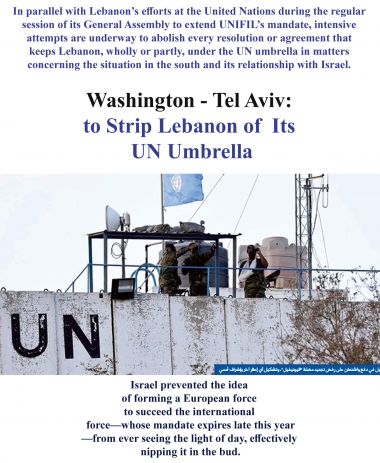
Today, following the 'support front war' and its repercussions, the conflict ended with an agreement issued and signed on 27 September 2024, grounded in the spirit and provisions of Resolution 1701. Israel, however, refused to implement it and reserved for itself a side agreement with the United States granting it freedom of action and retaliation without referring to the 'mechanism'. It went on to kill hundreds of citizens in the area south of the Litani River, clearly indicating that it was seeking another framework for managing the conflict along its border with Lebanon. Israel succeeded in pushing Washington to oppose renewing UNIFIL's mandate or establishing any other framework under UN supervision. It also prevented a proposal for a European force to succeed the international force, whose mandate expires later this year, from seeing the light of day. The proposal was aborted before it could take shape because Israel does not want any role for France or Spain.
There is now discussion of forming a civilian-missions team to succeed UNIFIL after its departure, just as there had been discussion months ago of entrusting the monitoring of the ceasefire's implementation to private American security companies, similar to what occurred in Iraq after the fall of Saddam Hussein's regime and the consequences that followed the conduct of those companies. Such a proposal, however, was rejected by the Lebanese Army, which did not consider it practical and believed it could open the door to disputes between personnel belonging to those companies and local citizens.
According to available information, Hezbollah - whose views were sounded out by Western and Arab parties regarding committees with civilian missions - rejected the idea outright. It replied that it remains committed to the agreement of 27 November 2024 and Resolution 1701 and would not retreat from either. It also rejects replacing them with any alternative framework, in order to keep Lebanon - at least theoretically for now - under the UN umbrella. On this point, it is aligned with Parliament Speaker Nabih Berri, who adheres to international legitimacy and refuses to compromise its role in any peace process concerning Lebanon, the future of its international border with Israel, or even a fraction of Lebanese territory.
Meanwhile, Lebanese parties do not conceal their concern over attempts to elevate the 'framework formula', which Speaker Berri described as 'provisional', to the United Nations so that it becomes one of its documents, even if unofficial. This could then make it easier to argue that it forms part of the UN body's records and to justify measures that would not necessarily serve Lebanon's stability.
The situation remains in intensive care and open to any development, without the ability to discern what form that development may take.
(Al-Jumhuriya) |