|
|
|
| Voices of harmony and multiculturalism drowned out voices of hatred and division. |
|
Philip Ruddock’s Book Nation Building Celebrates Immigration’s Transformative Role in Australia
22/09/2026
(See translation in Arabic section)
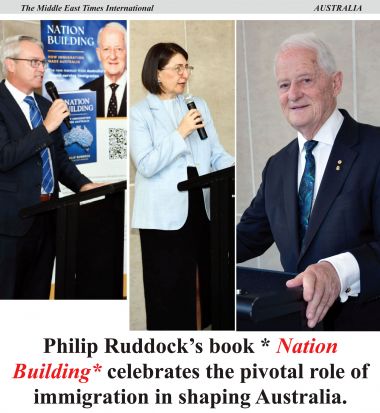
Sydney-Middle East Times Int'l: The Hon. Philip Ruddock AO—former federal MP and minister, Australia’s longest-serving immigration minister and the nation’s second-longest-serving federal parliamentarian—celebrated the launch of his book, Nation Building: How Immigration Made Australia, alongside his wife, Heather, and daughters, Kirsty and Caitlin.
The book explores immigration’s defining contribution to modern Australia, examining public consultation, social harmony, the lessons of the Fitzgerald Report, asylum seekers, skilled migration, family reunion, and Australia’s humanitarian and compassionate programs.
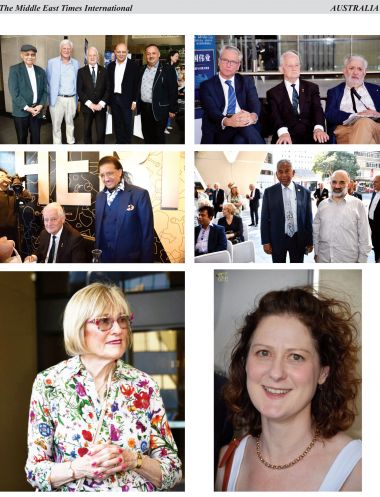
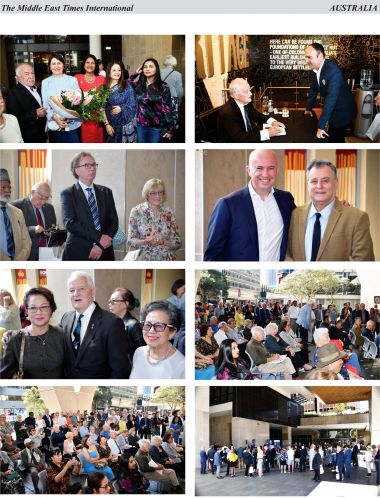
The event brought together representatives from Australia’s diverse cultural communities. Among those attending were former NSW premiers Gladys Berejiklian and Barry O’Farrell; former NSW minister Matt Kean, now Chair of the Climate Change Authority; former federal MP Laurie Ferguson; Tuong Quang Luu AO, the former State Director of Immigration in NSW, Parramatta Lord Mayor Martin Zaiter; businessman Anthony Sukari; and Sheikh Shafiq A. Khan, founder and president of Al-Faisal College in Auburn.
Local councillors, religious and community leaders, cultural and media representatives, and business owners were also in attendance.
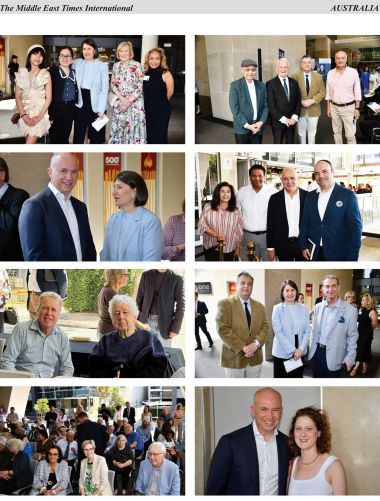
Master of ceremonies Tom Switzer paid tribute to Ruddock’s distinguished parliamentary career, describing him as a politician whose commitment to serious policymaking and attention to detail distinguished him throughout decades of public service.
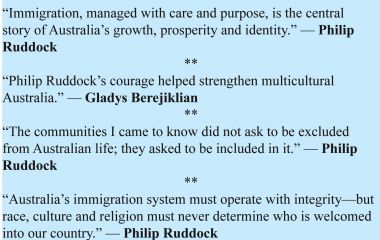
“Parliament is not what it used to be, and one reason is that there are fewer members like Philip Ruddock,” Switzer said.
“He made Australia a better country through his dedication to sound policy and careful attention to detail—not through social media posts. His ideas and persuasive personal style distinguished him throughout his long parliamentary career.”
Switzer recalled Ruddock’s ability to withstand intense parliamentary debate and media scrutiny, particularly during some of Australia’s most controversial political periods.
“Philip’s ideas and political style may now be out of fashion in Canberra, but Parliament and the country are, in my judgement, worse for their absence,” he said.
“Philip understands that the debate continues and that his ideas remain enduringly relevant, particularly in the critically important area of immigration.
“Australia needs more people like Philip Ruddock, although it was fortunate to have him when it did.”
Berejiklian: Immigration Is Central to Australia’s Success
Former NSW premier Gladys Berejiklian officially launched the book, praising Ruddock’s courage, compassion and enduring commitment to multicultural Australia.
Berejiklian said Australians had much to be proud of in a nation offering its citizens opportunities, freedoms and a quality of life available in very few other countries.
“At the heart of our success as a nation is the history of immigration,” she said.
“Migration has helped grow our population, strengthened our economy, renewed our workforce and expanded our understanding of what it means to belong to this wonderful country.”
Drawing on her own family’s experience, Berejiklian spoke of migrants—including her parents—who arrived in Australia with little more than ambition, resilience and hope, before building successful lives and contributing to their adopted nation.
However, she acknowledged that immigration had also tested Australia’s politics, institutions and sense of national identity, requiring difficult decisions and challenging discussions about borders, security and social cohesion.
Central to these debates, she said, was Ruddock: Australia’s longest-serving immigration minister, second-longest-serving federal parliamentarian and a lifelong advocate for multiculturalism.
“I am proud to have known Philip Ruddock for 30 years,” Berejiklian said. “I have always admired his courage, strength, compassion and work ethic. He has been a role model and mentor to me and to so many others.”
A Personal and Historical Value
Berejiklian described Nation Building as both a historical and deeply personal work, reflecting Ruddock’s experience in immigration and multicultural affairs and explaining the principles that guided him when making difficult decisions.
She recalled that by the time Ruddock became Minister for Immigration and Multicultural Affairs in 1996, he had already served in Federal Parliament for 23 years.
A dedicated student of Australian history, he understood the profound contribution made by successive waves of migration, while also recognising that immigration policy could come under pressure during periods of economic, political and social uncertainty.
Berejiklian traced the development of modern immigration policy from the restrictive White Australia era to Arthur Calwell’s post-war declaration that Australia must “populate or perish.”
Successive governments dismantled racial restrictions, established the framework for a modern immigration system and advanced the principles of multiculturalism.
The 1988 Fitzgerald Report sought to establish a coherent immigration philosophy, emphasising migration’s economic benefits while proposing a path forward for multiculturalism. It also prompted reforms that tightened entry requirements, reduced ministerial discretion and reshaped the regulatory framework.
During that period, Ruddock took the courageous decision to cross the floor of Parliament in support of a non-discriminatory immigration program.
“He believed then, as he does now, that immigration policy must be racially blind,” Berejiklian said.
“That decision defined Philip as a parliamentarian prepared to sacrifice his personal standing to uphold a principle fundamental to our national identity and to what it means to be Australian.”
Compassion and National Interest
During his years in opposition, Ruddock researched immigration policy, built relationships with multicultural communities and visited refugee camps across Africa, Asia and the Middle East.
These experiences exposed him to the scale of global displacement and the suffering of people forced from their homes, strengthening his determination to ensure that humanitarianism remained an essential part of Australia’s immigration system.
When he became minister, Australia’s program incorporated skilled, family and humanitarian streams. The continuing challenge was to achieve the correct balance among them while maintaining public confidence.
Ruddock saw immigration as an act of national self-definition: every decision about whom Australia admitted and in what numbers reflected the kind of country it sought to become.
He recognised Australia’s need for skilled migrants but remained equally committed to protecting the humanitarian and refugee programs.
“As minister, Philip demonstrated that humanitarianism and nation-building could coexist,” Berejiklian said.
Ruddock travelled throughout Australia for several months each year, holding public meetings in capital cities and regional communities. He listened to Australians’ concerns about migration policy and built relationships that have endured for decades.
Berejiklian also recalled Ruddock’s support during the divisive debate surrounding Pauline Hanson’s comments about Asian immigration in 1996.
As a young Liberal, she helped organise a rally against racism and contacted Ruddock’s office, hoping he would attend. To her surprise and delight, he accepted.
“That day, he showed me what political courage looked like,” she said.
“His presence was a significant public demonstration of the importance of defending the principles of our multicultural society, no matter the political circumstances.”
She said few Australians were as closely associated with multiculturalism—or as warmly regarded by multicultural communities—as Philip Ruddock.
He described the relationship between Australia and its migrant communities as a “reciprocal handshake”: people had the right to celebrate their cultural heritage, together with the responsibility to uphold the law and contribute to Australia’s success.
Protecting Integrity and Public Confidence
Berejiklian acknowledged that the 2001 Tampa incident was among the most controversial periods of Ruddock’s ministerial career.
It marked a turning point in Australian immigration policy and led to the Pacific Solution, elements of which continue to influence policy today.
The episode demonstrated, she said, the importance of maintaining an immigration program founded on integrity and consistency and capable of commanding the confidence of the Australian people.
She warned that Australia was again witnessing the politics of fear and division, which undervalued immigration’s contribution to nation-building and ignored the strength of a multicultural society.
For that reason, she said, Nation Building could not be more timely.
“Philip reminds us that Australia is stronger because of the choices it has made,” Berejiklian said.
“Our nation is wealthier, more resilient and better placed to confront demographic and economic pressures. This is a nation transformed—and Philip, your role in that transformation is undeniable.”
Ruddock Calls for a Balanced Migration Program
Addressing the gathering, Ruddock thanked his family for supporting him throughout a political career that frequently required him to be away from home.
He also acknowledged former colleagues and prominent legal figures, including Justice Peter Graham and former Solic-General David Bennett, as well as former Labor MP Laurie Ferguson.
Ruddock said Nation Building examined the essential policy foundations that must be carefully maintained to ensure Australia’s immigration program serves the national interest.
Australia required a balanced program that accommodated genuine close-family reunion, supported refugees facing the greatest need and attracted people with the skills required for the country’s future.
With more than 200 million displaced people worldwide and more than 30 million formally recognised refugees, Australia faced difficult choices about whom it could assist.
“We must work to identify those who need our help most, and that is extraordinarily challenging,” Ruddock said.
He questioned whether people who could afford to pay smugglers should receive priority over refugees unable to escape camps or dangerous conditions.
Since the 1970s, Ruddock has worked closely with refugee communities, including Vietnamese Australians. More recently, he has advocated for the Rohingya, many of whom live in camps in Cox’s Bazar, Bangladesh.
However, he emphasised that immigration was not solely about humanitarian assistance or family reunion. It was also about identifying people with the skills necessary to build Australia’s economy and secure its future.
The Fitzgerald Report found that between 70 and 80 per cent of migrants were entering Australia because of family connections, while the country was not attracting enough people with the skills its economy required.
Ruddock argued that Australia’s focus on skilled migration had contributed significantly to its prosperity and helped maintain a comparatively young population while many other nations were rapidly ageing.
“It is an immigration program designed to serve Australia’s national interests that has helped deliver these outcomes,” he said.
A System Free from Discrimination
Ruddock concluded by recalling his 1988 decision to cross the parliamentary floor in defence of the non-discriminatory immigration principles established by the Fraser government.
Those principles required migration decisions to be based on Australia’s needs, including essential skills, genuine family relationships and legitimate spousal commitments.
“The integrity of the system matters,” he said.
However, Ruddock stressed that protecting the immigration system’s integrity did not mean excluding people because of their culture, race or religion.
“Those are not factors that should determine whether someone is admitted to Australia,” he said.
“The fact that so many of you are here today demonstrates that Australia has recognised this important principle.”
Ruddock thanked those present for their friendship and support before encouraging them to read the book and consider immigration’s fundamental role in building a prosperous, cohesive and confident Australia. |
|
|
|
|
|