|
|
|
| Former US envoy Arthur Sinodinos opens up on the Trump effect at ALCC networking business luncheon |
** “When you think about trade, think about the interest in Australia to do
more trade with the Middle East and think about the role Lebanon can
play as a gateway to the Middle East.” Arthur Sinodinos
|
Former US envoy Arthur Sinodinos opens up on the Trump effect at ALCC networking business luncheon
01/07/2025
(See translation in Arabic section)
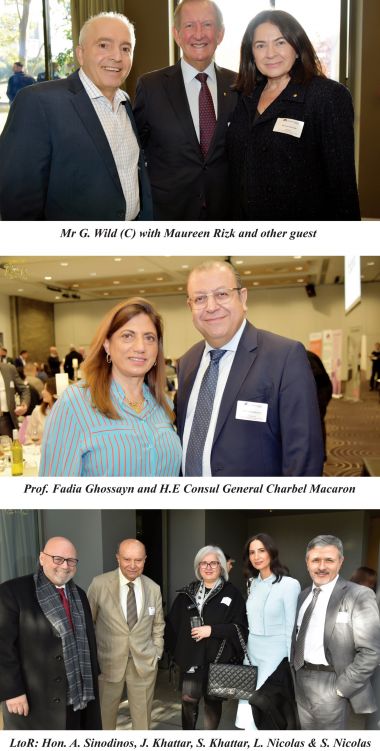
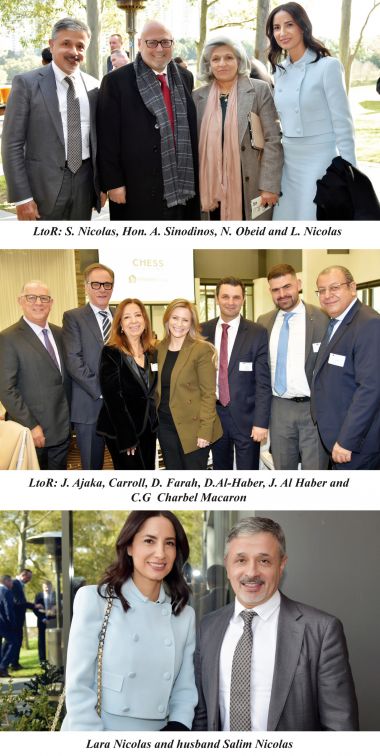
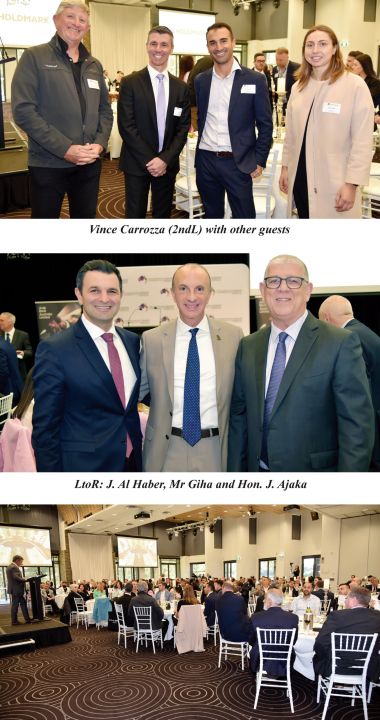
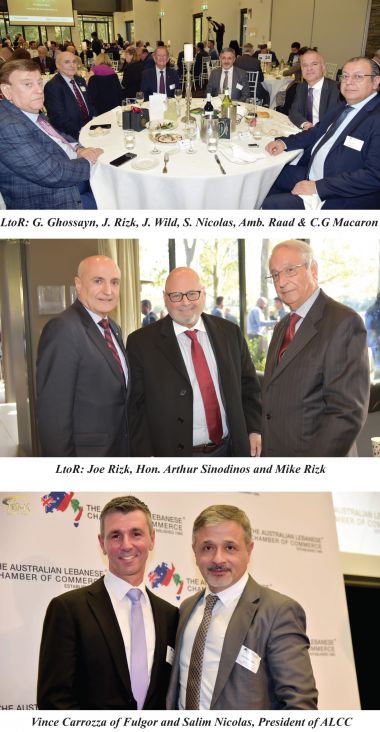
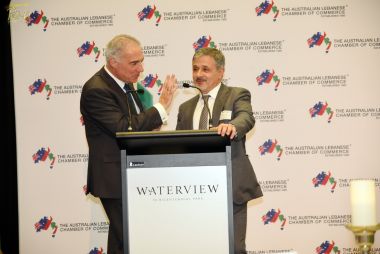
Sydney-Middle East Times Int'l: The Lebanese-Australian Chamber of Commerce hosted a networking luncheon, attended by Chamber President Salim Nicolas and wife Lara, as well as business owners and entrepreneurs. The guest speaker was partner and chairman of TAG’s Australia Practice, former ambassador to US and Liberal politicians Arthur Sinodinos. Among those present were Lebanon’s Ambassador to Australia, Milad Raad, and wife Roula Azar; Lebanon Consul General in Sydney, Charbel Macaron, and wife Joelle; the CEO of Arab Bank Australia, Joseph Rizk, and wife Maureen; Arab Bank Australia president Jeff Wild; My Guardian Foundation president Jean Ajaka; chamber vice-president Joe Khattar and wife Shad; chamber's International Relations Officer Michael Rizk; businessman George Ghossayn and wife Fadia and media representatives. The event began with a speech by Master of Ceremonies Paul Nicolaou welcoming the dignitaries and attendees. After that, the President of the Lebanese-Australian Chamber of Commerce (ALCC), Salim Nicolas, delivered a speech, excerpts from which are below. The words of thanks were delivered by Vince Carrozza of FULGOR, the event sponsor.
Normally, when we witness an action and its outcome, this is better known as ‘cause and effect’. When the cause is strong, and the effect is powerful, we arrive at disruption. No matter what you think of US President Donald Trump, disruption is his middle name. Although no one seeks it, disruption can be humbling or humiliating. It can be dynamic and depleting. No matter what, it demands our attention and its advisable to pay attention.
As this is our 40th year, I wanted to reflect upon our chamber’s origins. Since arriving in Australia 171 years ago, the Lebanese embraced the spirit of mateship. Currently, Australia is home to more than 330,000 people of Lebanese ancestry. My family and I arrived in 1984; one year later, when this chamber was formed (1985), my twin brother Daniel and I had turned 18.
In that year, our prime minister was Bob Hawke. In the frame were John Howard, Neville Wran, Paul Keating and our honoured guest, Arthur Sinodinos who was 28 years old and working for the Treasury.
That year Coles and Myer joined forces, the capital gains tax was introduced, Neighbours first went to air, Australia’s Formula One Grand Prix was held in Adelaide, DNA was first used in a criminal case, the wreck of the Titanic was located, Emirates airlines was established in Dubai, the first Microsoft Windows operating system was released and the world’s first internet address was registered.
These days “networking” refers to meeting people for business or personal gain. In our Lebanese culture, networking serves a different function. We break bread in order to forge robust communities. To us, community, is a hub where strong alliances turn colleagues into friends and friends into family. Indeed, we are proud Australians, infused with the best of the Lebanese ethos. I encourage you to support each other in order to nourish the roots of this chamber and to strengthen our formidable family tree. When our communities know us to be true and honest, our community becomes our fan club. When we share as we sow, and we share as we recap, our community becomes our army.
As I return the lecture to our MC, I praise our esteemed members and sponsors and say, “Here’s to your prosperity”.
ARTHUR SINODINOS
I think this is the best country in the world. One reason why is because you and your forebears made the choice to come to this country and make this country what it is today. In particular, I salute the Lebanese community and the chamber; its very effective leadership is demonstrating to the rest of the community about what groups like this can do for Australia.
I think business chambers in particular are very important because having so many people from other countries gives us a great resource to encourage trading investment with the rest of the world. We should leverage that so all strength to your arm.
Now, I was invited here to talk a bit about what’s happening in the world.
We’re going to have a bit of a session; I can’t possibly hope to cover everything but I want to leave you with a few ideas.
The first one, and already alluded to, is that disruption is a constant; in other words, it’s going to continue to happen. No one, no industry, no segment, no part of the labour force is immune to disruption but the first way to deal with disruption is with the mindset that this is inevitable; it will happen so how do you deal with it? How do you put yourself in charge of it and have agency. That is what is important.
US President Donald Trump is a force of disruption. He didn’t cause the polarisation that we see in America; he’s a symptom of it. He was elected president because a majority of Americans thought that America was not going in the right direction and he offered change.
Those people who voted for him were not happy with their situation. They were not happy at the economy even though it was growing strongly; a source of concern for them is the southern border which looks pretty open and causing issues around regulating the flow of people into the US.
So, there were solid reasons why people voted for a change. I think the American people are now finding they got more than they bargained for when it comes to change.
The philosophy of the Trump administration was to flood the zone, to create change across different areas; social, economic, political, international. He says America needs to think about domestic problems and not worry so much about the rest of the world so America First is the guiding light of US policy.
On the domestic front, he argued there was too much political correctness and tried to turn the clock back on that. On the economy he argued that international trade disadvantaged the US. I don’t agree with that statement but his view is they need to bring back manufacturing to the US. He has a view of America from the 1950s and ‘60s when America was on top in terms of manufacturing, economy etc.
He thinks tariffs are the way to do that; he thinks that they raise money, that that money is paid for by foreigners and which can help pay for the other expenses of Federal Government including tax cuts. He believes that tariffs have a protective effect; they’re a negative incentive that will encourage other countries to invest more in the US.
He started to put this program into action and we’ve seen that he’s now seeking to negotiate trade deals across the world. He did one with the UK and India are very keen on a deal but a lot of other countries are hanging back because they’re uncertain about what will happen particularly on China.
So, in dealing with China, Trump found that other countries can fight back. What the Chinese did was to say ‘well, okay, we’ll put up our tariffs but we’ll also restrict the supply of critical minerals to the US that are necessary for factories, magnets, defence materials’ -- these sorts of critical minerals of which China dominates the supply, extraction and processing.
So, in London a couple of weekends ago, the Americans agreed to take off some controls that they’ve put on China around semiconductors and other things in return for the Chinese taking off their controls. The Chinese played their hand well; they don’t necessarily have a strong hand but they’ve played it well. A lot of other countries are hanging back, waiting to see what happens, because they want to see where tariffs between America and China end up.
There is a pervasive uncertainty at the moment about where tariffs will go such as the impact of higher tariffs on the US economy in terms of costs because it’s US consumers that will pay for US tariffs.
There’s concern that costs could go up and which creates a dilemma if you’re the central bank in the US, (Federal Reserve) about which way interest rates should go.
Trump has a very interesting solution to that; next year he wants to replace the chairman of the Fed with someone he thinks will be more sympathetic to lowering interest rates. The problem is that if you artificially lower rates, that can be inflationary as well and real interest rates will go up.
What’s happening in the rest of the world, with uncertainty around trade and tariffs, means that there could be an impact on global trade and investment which could slow down with tariffs going up everywhere. Another effect, one we’re seeing here in Australia, is thinking about who else can we trade more with.
So, we’ve restarted negotiations on an EU-Australia free trade agreement. The government’s strategy is diversifying trade to not be so dependent on the Americans. (By the way, PM Anthony Albanese is not rushing to do a trade deal with the Americans because he doesn’t want to give away too much in return for maybe not getting much as Trump’s 10% tariff is unlikely to be taken off for Australia and we’re at the low end of tariffs.)
The reality is this: global trade and investment could be lower but countries are looking to do more trade with each other. When you think about trade, think about the interest in Australia to do more trade with the Middle East and think about the role Lebanon can play as a gateway to the Middle East.
We have to think more laterally than we did before, to try to hedge against relying too much on the US; that’s where Australian policy, I think is going.
On the military side, there’s something similar going on. Australia and the EU are talking about a defence pact; not an alliance but co-operation on defence. We’re looking to do more business in South-East Asia and with our partners in Japan and Korea. Countries are looking at how they hedge. The thing that we cannot control is events in places like the Middle East.
Every time America says “we want to pivot to the Indo-Pacific”, the main challenge is to counter China who are pushing the US out of the Indo-Pacific as much as they can.
Countries in the region like us say “we want the US in the region as a counter-balance”. Some countries won’t say it openly, particularly in South-East Asia, but that’s what they want; that’s what Australia wants. That’s why we have an alliance with the US.
What we are saying to the Americans is “okay, you can talk about America First but your security depends a lot on what happens in our region. It’s not that we need you but you need us” because of our facilities and everything else that we can provide to the Americans in this part of the world.
Does that us to be more vulnerable? Yes, in a sense, but we also get the benefit of the strategic deterrence of being part of that alliance.
So, in a world of America First, you have to keep reminding Americans as to why it’ll be in their interest to be part of these alliances.
In a world like this, when you look at it from a business point of view, you can calculate risk, measure risk, take strategies; with uncertainty, there’s often a view that can you sort of sit on your hands and wait. To some extent with tariffs and trade, that’s what’s happening now.
We’re also about to have-- you may have heard this – “the big, beautiful build” which is a tax cut that the US president wants to enact which will extend the life of the tax cuts he had in his first administration. This will add US$3 trillion to the deficit and debt over the next decade. The problem is the markets are worried about the impact that that will have on inflation.
So, at the moment the president has only two real constraints. One is public opinion and the other is the bond market.
When tariffs were causing a meltdown on the financial markets, Treasury Secretary Scott Bessent and Commerce Secretary Howard Lutnick went to the president and used the evidence of what was happening in the markets to say ‘let’s stop and have a pause on tariffs’ so that’s one mechanism that he does respect. So where does this all go?
Political commentators in the US are looking at the middle of next year because by then we will have a clear indication of how popular or unpopular the president is, what impact his policies will have had. He is losing popularity, some Republicans are acting now and will start to move away and there could be a reaction in the midterm elections at the end of 2026; traditionally the Trump administration have lost seats at that election.
In this case, if the Democrats took back the House and the Senate, the last two years of the president’s term will be dominated by political fighting in Congress and may constrain what he can do domestically.
In terms of how it impacts Australia … if there are circumstances where the US dollar is going up relatively to the Australian dollar, that’s potentially inflationary in Australia. So, there are all sorts of factors to take into account.
QUESTION AND ANSWER WITH SINODINOS Q&A
MC: What do you think is going to happen with Palestine? I mean he came out with some grandiose plan there . What do you think is going to happen there?
SINODINOS: Essentially, it’s now left up to the Israelis to do what they’re doing in Gaza. You can see it on the TV screen every night so it’s not clear whether the people of Gaza end up like the Kurds with no state of their own and at the mercy of the countries that can accommodate them so there seems no solution to that because there’s a very strong bloc within Israel that wants to annex the West Bank and Gaza. Of course, the US president’s interest now has been diverted so they essentially have a free hand.
MC: We saw that our prime minister did not get to meet with the president who had cancelled a range of other meetings with other world leaders. Do you think that our ambassador, former PM Kevin Rudd will be able to facilitate another meeting?
SINODINOS: Well, the minute they heard that they couldn’t have the meeting in Alberta, they immediately started working on a possible meeting but there’s a risk. Do you set up a meeting and risk that getting cancelled again or do you take the chance and get on a plane and go back out there? But he needs to see the president sooner rather than later, because there’s trading issues and other things where we need to hear directly from the president. I think he’ll want to get onto it sooner rather than later.
MC: if that meeting does happen, what do you think is going to be discussed?
SINODINOS: Well, on trade, PM Anthony Albanese made the point that we can do more of a partnership around critical minerals; that’s pretty strategic. We could be the place for data centres because we’ve got the land, and we’ve got potentially the energy resources but we’ve got to reduce the cost of energy in terms of our international competitiveness.
MC: Tell me — Trump economics. Is that good for the world, bad for the world or don’t know what the impact will be?
SINODINOS: If you ask Trump, he will say that’s the wrong question. It’s what’s right for America and that’s the challenge. Since the end of World War 2, we worked on the basis that the US essentially guaranteed the international order; part of that order was tariffs and trade regulated between countries and countries working to being more open because we all benefited from free trade and investment. He thinks that that system screwed America so his view is what’s good for America is to bring more trade back to the US. The challenge he faces is that while may be it encourages more investment and manufacturing in the US, they have to have labour. They have to have supply chains; there’s a whole series of things for that to happen and also the fact that America is a big service economy; a lot of what America exports to the world is in services – financial, intellectual, you can go through the list. So while this policy focus on tariffs is very much about goods, it’s a very 40s, 50s, 60s view of trade.
MC: What impact will Trump economics have on the Australian economy?
SINODINOS: If trade and global trade investments go off, particularly if China is affected, that flows through to us in terms of slower growth. The challenge we face as a country is productivity growth is not growing strongly, cost of living pressures are still there, so we need to find ways to raise our rate of growth. Population has been boosting our GDP but if you look at our GDP per head of population it’s been going down. We need to become more productive in a world of uncertainty; we have to be more productive and more resilient and more flexible. There’s a lot of strength in the Australian economy, but we got to build on them. This is the time.
MC: The Prime Minister wants to hold a forum in Canberra to discuss productivity then the Federal Treasurer announced tax reform. These are all positive things. Your thoughts?
SINODINOS: They are. It depends on what extent to what they get a consensus around real reforms that can impact our economic performance. Industrial relations, clearly for the Labour Party, is a no-go area and that’s a big challenge because flexibility in that area, especially for our exports, is going to be important. On tax reform, the concern is if it will contribute to getting the budget under control, which means the overall tax take has got to go up. The question is where will it come from? They’re not going to touch the GST but they may reform income tax. When we did tax reform in 2000, and the GST, we were able to super-charge income tax cuts because we had a surplus in the budget; we could draw down on that surplus because we wanted to be able to bribe the losers because we were making a switch with GST. Who will make the net contribution to improving the budget bottom line?
MC: With his big majority does PM Albanese have the appetite to make changes or will he just manage the economy the best he can?
SINODINOS: If Labor want a mandate for more radical change, I think it is in the Prime Minister’s mind that that is something he will put to the people at the next election. The question is how ambitious is the government on tax, economic reform or do we need a crisis to go in a certain direction? |
| 
| 
| |
|
|
|
|