|
|
|
| ALCC Celebrates Business Excellence and Empowers the Next Generation |
** “This Chamber has enjoyed the fruit and shade of the trees planted by our founders. Now, it’s our turn to support emerging leaders.” — Salim Nicolas, AM **
“Ambition determines how far we dream. Dedication determines how far we travel.” — Salim Nicolas **
“I am proud to be Lebanese-born and Australian-raised. I have Lebanese blood and an Australian heartbeat.” — Jihad Dib, MP **
“We love being Australian, and we love being Lebanese. We never forget where we come from.” — Jihad Dib, MP
|
ALCC Celebrates Business Excellence and Empowers the Next Generation
11/11/2026
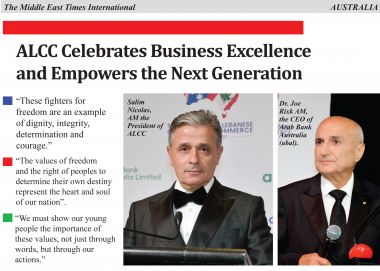
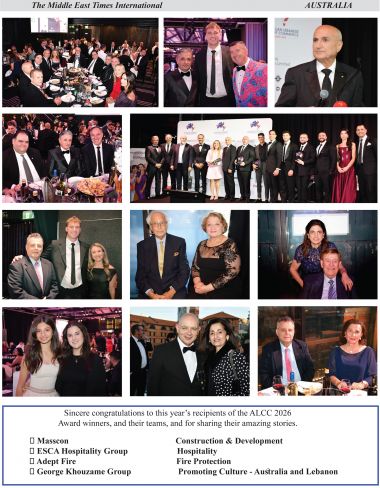
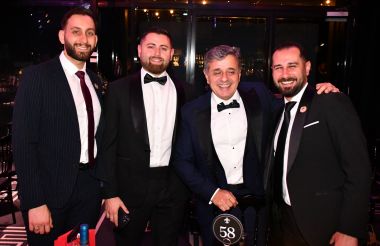
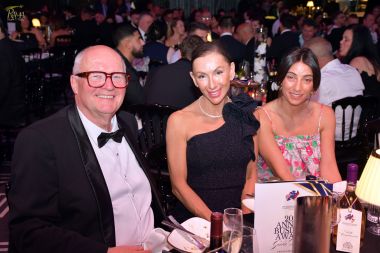
Sydney-Middle East Times Int'l: The Australian Lebanese Chamber of Commerce (ALCC) held its 2026 Annual Business Awards Gala at Doltone House, attended by a large gathering of guests, including Chamber President Salim Nicolas AM; Lebanon’s Consul-General in Sydney, His Excellency Raymond El Chamlati; the Hon. Jihad Dib, Minister for Customer Service and Digital Government, Emergency Services, and Youth Justice; A delegation from (SHC)insurance brokers; former politician John Ajaka; Arab Bank Australia CEO Joseph Rizk; and businessman Sarkis Nassif, President of the Sydney–Australia Chapter of the Maronite Foundation for Integral Development.
Also attending were ALCC Vice-President Dr Anthony Hachem AM; Camil Shalala, President of the Australian Lebanese Christian Council and journalist; businessmen Danny Nicolas AM, Richard Andary and Anthony Sukari; David Isaac, head of Harkola; and a delegation from SHC.
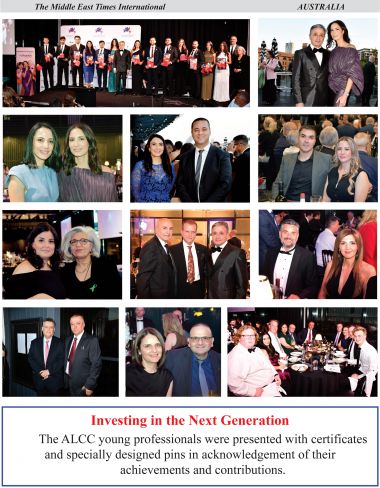
The gala highlighted the talents of the younger generation of professionals, encouraging them to continue the tradition of success and achievement. It also recognised Lebanese Australians whose outstanding accomplishments across various industries and fields have strengthened the Australian economy and contributed to the nation’s development and prosperity. The occasion reflected the Chamber’s tireless efforts to support and celebrate these contributions.
The evening featured the introduction of the inaugural Young Professionals cohort and the presentation of awards to business achievers. It also highlighted research into heart disease and cancer. Harkola provided bottles of wine and olive oil, which were distributed to guests.
Edited excerpts from the evening’s addresses follow.
ALCC President Salim Nicolas AM
Good evening, dear friends. Last year, during our 40th anniversary, I was reminded of an old proverb: “A community grows stronger when one generation plants seeds for the next.”
This Chamber has enjoyed the fruit and shade of the trees planted by our founders. Now, it’s our turn to support emerging leaders. That’s why the Board ratified the Young Professionals Chapter. No doubt you’ve met young people searching for career advice. Many would have asked you, “What’s the secret to your success?”
What is success? For me, there’s a big difference between success and achievement. Success without contentment is hollow. And achievement without purpose is bland. That’s why I encourage emerging Young Professionals to sharpen four skills. The first is observation.
You’ve seen these power points everywhere. But have you noticed that the two switches don’t line up with the holes? They are off-centre. Of course, it doesn’t matter. But it matters that you notice!
Apple, Google and Samsung have a combined value of $15 trillion. Even these tech giants give us things to question. Look at their phones. Why are there letters of the alphabet beneath the numbers? They were useful a century ago. Why are they still here? If we do need the alphabet, why are no letters assigned to one and zero? When we restart our phones, we must enter our passcodes. If we are encouraged to turn a four-digit passcode into a memorable word, and we exclude one and zero, we diminish our security by more than half. To complicate matters, ATMs use different alphanumeric keypads, as shown here.
The second skill that can help young people advance their careers is curiosity. Here’s an example: do you add salt to the water when boiling an egg? Perhaps you think salt stops the egg from cracking. Or that it prevents the egg white from leaking if the shell does crack. Some believe salt makes eggs easier to peel. Or that salt improves their flavour. Others believe salt raises the boiling point, helping the egg cook faster. This could be useful if you’re short on time… or low on gas.
Of course, some have no idea why they add salt. They are simply copying their grandmother! It’s amazing—and worrying—that people do the same things for vastly different reasons. Or they do things without understanding the consequences. That’s why I encourage our future leaders to be observant and curious.
Observation helps us notice.
Curiosity encourages us to question.
The third skill is ambition. Consider Dr Huda Zoghbi, who fled the war in Lebanon and pursued her medical ambitions in the USA. After sixteen years of difficult research, she helped discover the genetic cause of a devastating condition called Rett syndrome.
The fourth skill I recommend is dedication. It gives us the courage to persist. Australia’s first saint, Mary MacKillop, dedicated her life to educating poor children. By 1871, her Order had grown to 127 Sisters working in 41 schools. She faced crushing opposition, yet never gave up. Now, 155 years later, a community in Lebanon is building a chapel in her honour.
Ambition determines how far we dream.
Dedication determines how far we travel.
Tonight, we formally welcome our Young Professionals by presenting each with a certificate and a pin. I can’t wait for you to meet them. They will fill your hearts with hope and pride. Please hold your applause until all the names have been announced. Then, we’ll invite everyone to the stage, along with Miss Nadia Obeid, Mr Jack Maalouf and Mr Stefan Hicks.
Inaugural Young Professionals
Jonah Arraj
Jackie Boustani
Mia Chaaya
Antonio Chalita
Chanelle Hasham
Elie Maamary
Lama Makkouk
Julian Murr
Angelo Nicolas
Matthew Nicolas
Roger Saba
Grace Sukari
Lauren Sukari
Dear friends, I invite every member to share their experiences with our Young Professionals so they can become street-smart and business-savvy. We often hear the words graduation and degree. Both words come from the Latin for step—climbing gradually, one step at a time, in small degrees. I feel certain that, in the near future, these delightful young members will step up as the custodians of this remarkable Chamber.
Later tonight, we will salute the award winners, whose journeys are a masterclass in what is possible when observation and curiosity are fuelled by ambition and dedication.
The Australian Lebanese Chamber of Commerce continues to grow in size, in heart and in service. There is something so special about being both Lebanese and Australian. From our Lebanese heritage comes a thirst for knowledge, enterprise, family and community. Our Australian spirit brings a belief in mateship, opportunity, high standards and giving everyone a fair go.
For now, I say welcome, and thank you.
** ** ** Minister Jihad Dib, MP
This year, I decided to write a speech. Last year, I didn’t, and things went a bit downhill. I thought I was a stand-up comedian, but it didn’t quite work. So I was told I had to write a speech this year. I’ve written one—but that doesn’t mean I’m going to read it!
Before I forget, can I thank and acknowledge Salim Nicolas? Please give him a big round of applause for an absolutely amazing speech.
I’m glad we had the dinner break before my speech, because it gave me time to think about what I was going to say after such a thoughtful address.
I did make one mistake today. I thought, “I won’t wear a bow tie because I wore one last year. It’s a black-tie event, so I’ll wear a black tie.”
Everything was going well until I was waiting outside and someone handed me their car keys, thinking I was the valet. So, if you own a BMW X5, you’ll find it on Marketplace. I’ve put it up for sale, and I’m asking a good price!
We Lebanese people like a good deal, don’t we?
That was supposed to be funny. Obviously, it wasn’t!
More importantly, tonight is a celebration of who we are. I am proud to be Lebanese-born and Australian-raised. I have Lebanese blood and an Australian heartbeat.
I think that would be true of pretty much everyone in this room—except perhaps those who arrived without realising this was a Lebanese event. You’re most welcome, too!
The Lebanese diaspora didn’t simply arrive in Australia in the 1970s. Our history here goes back much further.
Those early migrants came from the area we now call Lebanon, then part of the broader region known as Syria or the Levant. Many settled in and around Redfern, which became a “Little Lebanon”, where churches and community institutions began to take shape.
In the spirit of tonight, those pioneering Lebanese did what Lebanese people do: they established businesses.
We are entrepreneurial people. Wherever we go, we try to sell something. And if we’re buying something, we never want to pay full price. We want to bargain—and we want a better deal than our neighbour got! That’s just the way we are.
When later waves of Lebanese migrants arrived, they faced enormous challenges. Under the White Australia policy, finding work and feeling accepted could be very difficult.
Who helped them? The earlier traders who had established shops in and around Redfern, including businesses selling manchester and other household goods.
They helped newcomers by lending them small amounts of money and supplying goods they could carry—threads, manchester, underwear, socks and other everyday items. They encouraged them to travel into regional communities and sell those goods as hawkers.
That is part of the story of Lebanese ingenuity and entrepreneurship in Australia.
But more important than the business story is the spirit we saw here tonight, when young people were recognised, encouraged and supported.
Those early Lebanese migrants travelled a world away to a country where people did not speak Arabic and where everything was unfamiliar. What helped them through was the support of their Lebanese brothers and sisters.
That spirit continues today.
We are an amazing community, and I am incredibly proud of it. When I stand in Parliament, I carry that Lebanese identity with me, and I enjoy it.
With the Metro, what excites me is that we can travel to new places, but also that people can come and spend time with us.
On a serious note, it is about people getting to know one another. There is so much hate at the moment, and such a lack of compassion. If we take a moment to remember who we are, care for one another and show compassion, we can do a great deal of good.
** ** At the weekend, I was in Punchbowl and noticed people who were clearly new to the area.
What gave them away? First, they were quiet and travelling in small groups. Second, they actually lined up to be served! They also wanted to pay by card and asked for receipts. I thought, “They’re definitely visiting!”
Whether other people think we’re funny doesn’t matter. We think we’re funny—that’s all that matters!
We love life. We love one another. We love being Australian, and we love being Lebanese. We never forget where we come from.
As Minister for Emergency Services, I have the opportunity to travel across the state. Nothing makes me prouder than visiting small communities and seeing Lebanese names on buildings.
If you look closely enough, you can see the Lebanese migration story right across New South Wales—a story that continues today.
Thank you for everything you do.
Heart Research Institute CEO
This is a fantastic evening, but that’s a very tough question. It’s like asking which is my favourite child! There are so many discoveries emerging every day. I wish we had more time to do more.
Among the examples from the last couple of years is research into the causes of narrowed arteries in the legs. We call this the Cinderella of heart disease, because people think about the heart but often overlook the arteries in the legs.
We are investigating a chemical involved in this process, with the aim of developing ways to prevent amputations.
Another of my absolute favourites is the technology we are developing to prevent a consequence of advances in cancer treatment.
Our hearts go out to the Children’s Cancer Centre in Lebanon and its work treating childhood cancer. Researchers have made progress in this field, but some of the new drugs have the potential to damage the heart.
Imagine your child surviving cancer, only to develop heart disease ten years later. We are trying to develop technology to prevent that from happening.
We take a blood sample from a patient when they are diagnosed with cancer. Their cancer treatment may require particular drugs, but we know those drugs can carry a risk of heart damage.
From that blood sample, we grow 50 or 100 mini hearts that are genetically identical to the patient. We then test the drugs on them to see whether that person is resistant or sensitive to their effects. This could help prevent heart complications.
There are several other projects, but I’m sure you don’t want me speaking for the rest of the evening!
On the importance of community support
At the Heart Research Institute, we research the heart and blood vessels. We can only do what our resources allow.
We recruit some of the brightest young minds, including people like those in this audience and their children who may want to pursue research.
But those young researchers need support. They need laboratories, equipment and supervision.
How tragic would it be if someone had a brilliant idea but could not pursue it because we lacked the resources? If we have to say, “I’m sorry, the budget is not enough to employ you next year,” that person might be lost to medical research for the rest of their life.
We depend on community support. It is the same spirit we see here tonight: coming together because we can achieve much more as a group.
That support gives us the purpose and the will to go on. |
| |
|
|
|
|