|
|
|
| Burke Unveils Sweeping Migration Reforms to Restore Control and Confidence |
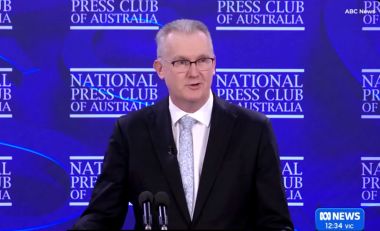
MP Tony Burke, the Minister for Immigration... ** “We need immigration—but it must be targeted to Australia’s needs, support our economy and retain the confidence of the Australian people.”
|
Burke Unveils Sweeping Migration Reforms to Restore Control and Confidence
Subjects: Immigration reform, temporary visas and student visas
Thursday, 17 September 2026
National Press Club of Australia
(See translation in Arabic section)
Sydney-Middle East Times Int'l: Immigration is fundamentally a strength for Australia, and the ultimate expression of the migration journey is Australian citizenship.
Citizenship ceremonies are among our most joyful and patriotic occasions. At the end of their migration journey, new citizens make a lifelong pledge to Australia, and the nation responds with two simple words: “Welcome home.”
While Australia must continually address challenges within its immigration system, we should never lose sight of migration’s extraordinary contribution to the fabric of modern multicultural Australia.
Some countries describe themselves as a melting pot, but that is not how I see Australia. In a melting pot, everything loses its identity and dissolves. Australia is more like an orchestra: harmony is not achieved by making every instrument the same, but by enabling different instruments to work together. That has been central to the success of the Australian project.
We are capable of having a mature debate about immigration, but that requires challenging several misleading claims.
The first is that Australia is experiencing mass migration. Before the pandemic, the Intergenerational Report projected Australia’s population for 2030–31. When we reach that point, the population is expected to be around 700,000 lower than projected before the pandemic.
There was a post-pandemic migration peak, and it was too high. However, net overseas migration has now fallen 47 per cent from that peak and is tracking in line with—or slightly below—the figures contained in the most recent Budget.
Another misleading argument is that some visa categories, such as the Pacific Australia Labour Mobility program or working holiday-maker visas, are irrelevant to net overseas migration. Every part of the immigration program contributes to the overall figure. Last year, backpackers alone contributed 48,000 to net overseas migration.
Some people say they want immigration reduced but refuse to identify which visa categories should be affected, especially when their industries or communities rely upon them.
It is also incorrect to claim that immigration is necessary only in regional Australia. Migration is critical to regional economies, but it is equally important to our cities.
International education, for example, is a major Australian export that supports not only teachers and educational institutions, but also cleaners, maintenance workers, accommodation providers, retailers and many other businesses. Drastic reductions in migration would carry economic consequences across both metropolitan and regional Australia.
Housing construction also depends heavily on migrant labour. In Sydney and Melbourne, close to two-thirds of plasterers were born overseas.
Australia needs immigration, but it must be targeted to the nation’s economic and social requirements, with numbers and visa categories appropriately managed.
Another repeated claim is that the Government is bringing in yoga teachers instead of construction workers. The facts tell a very different story.
The number of construction workers entering Australia has tripled—from around 4,500 to almost 15,000 last financial year. By comparison, the number of yoga teachers brought in by this Government is zero.
Yoga teachers remain on the relevant list because of an agreement reached with India by the previous government. Repeating demonstrably false claims only undermines the possibility of a serious national discussion.
There are, however, genuine problems that must be addressed.
For decades, large sections of Australia’s immigration system operated on a demand-driven basis. The assumption was that if employers could recruit the workers they needed and educational institutions could attract fee-paying students, housing and infrastructure would take care of themselves.
That is no longer the experience of Australians. People now expect the Government to exercise greater control over migration levels and ensure they align with available housing, infrastructure and national priorities.
The second genuine problem is visa hopping.
Movement between visa categories is not always inappropriate. When an international student completes a qualification in an area of skills shortage, progresses to a graduate visa, secures relevant employment, receives employer sponsorship and later becomes a permanent resident and citizen, the system is working as intended.
The problem occurs when people who would not qualify for permanent residency repeatedly move between visa categories and use appeals to prolong their stay until removal becomes increasingly difficult. Some eventually establish deep community and family ties, including having Australian-born children, despite never having had a legitimate pathway to remain permanently.
The third major challenge concerns housing.
Australia’s housing shortage was not caused solely by immigration, but migration policy must be part of the solution.
Since the Hawke government, Australia’s population has increased by approximately 75 per cent, while the number of homes has increased by about 100 per cent. Yet housing pressure has intensified because average household size has declined from 2.9 people to 2.5.
Every reduction of 0.1 in average household size creates demand for approximately 450,000 additional homes.
Australians have every right to decide how many people they want living in their households. Following the COVID-19 pandemic, many chose to live with fewer people. However, that change has significantly increased housing demand.
Migration needs to soften sufficiently to allow housing supply to catch up. At the same time, Australia requires skilled migrants—particularly construction workers—to build the homes the country needs.
The Government’s reforms can be summarised under three headings: who arrives, who stays and who leaves.
Who Arrives
The first reform concerns the skilled migration points test, a major economic driver of the migration program.
Following consultation with Treasury, the points test will be redesigned to ensure that Australia receives the greatest possible economic benefit from permanent skilled migration.
The revised system will also allow additional recognition of occupations that meet urgent national priorities. While university qualifications have traditionally attracted more points than TAFE or trade qualifications, people qualified in housing construction trades will receive points equivalent to a university qualification.
This will help attract the construction workers Australia urgently needs to increase housing supply.
The Government will also revise Ministerial Direction 119, which determines priorities for visa processing. The existing system applies almost identical priorities to temporary and permanent visas, sometimes creating unnecessary delays.
The updated priority list will include construction, agriculture, fisheries, resources and teaching.
Processing times for primary working holiday-maker applications will also return to previous standards for nationalities whose visa arrangements require regional work to qualify for a second or third year.
Different arrangements will continue for applicants from the United Kingdom, where regional work is not required under the free trade agreement. The number of British working holiday-makers in Australia has risen sharply—from around 17,000 at the end of the pandemic, with a previous peak of about 35,000, to almost 80,000.
The Government will continue discussions with the United Kingdom about managing this growth constructively.
Significant changes will also apply to student and graduate visas.
At present, international students may generally include family members in their visa applications from the beginning. Under the reforms, international students and graduate visa holders will no longer automatically be able to bring accompanying family members.
Families already in Australia will not be separated, and the change will not operate retrospectively. Special arrangements will remain for students from Pacific and ASEAN countries and for people undertaking certain advanced courses, including PhDs.
An expression-of-interest system would provide the Government with even greater control over student numbers and help address the limitations of a demand-driven system. However, implementing that measure will require legislation.
Who Stays
Further reforms will apply to working holiday-makers seeking second- and third-year visas.
Applicants will still be required to complete the existing periods of regional work—88 days for a second-year visa and six months for a third-year visa. However, meeting those conditions will qualify applicants to enter a ballot rather than guarantee another visa.
The ballot for second-year visas will be capped at 45,000 places. Last year, approximately 57,000 people qualified.
Third-year visas will be limited far more significantly, with only 5,000 places available through a ballot, compared with approximately 31,000 qualifying applicants last year. The United Kingdom will remain exempt because of the free trade agreement.
Visitor visa conditions will also be tightened.
Currently, a person overseas who applies openly for a partner visa may wait several years. However, someone may enter Australia on a visitor visa, apply for another visa after arrival and remain on a bridging visa. This inconsistency has undermined confidence in the system.
It has also made it harder to approve genuine visitor visas for people seeking to attend weddings, visit elderly relatives or participate in important family occasions. Officials must be satisfied that the proposed visit is genuinely temporary, and current practices make that assessment more difficult.
Future visitor visas will therefore include a “no further stay” condition for most visa categories. Protection applications will remain exempt.
The reform will not affect people already in Australia. It will apply only to future visas. It should also make it easier for genuine visitors—including partners waiting overseas for a spouse visa—to visit Australia temporarily while their permanent applications are processed.
Student visa rules will also be strengthened to prevent misuse.
Students may still seek reasonable extensions when circumstances beyond their control prevent them from completing their courses, such as serious illness or the closure of their educational institution.
Students who genuinely need to transfer between equivalent courses will be required to apply for a new visa, allowing authorities to assess whether the transfer is legitimate.
The principal change concerns academic progression. Some people complete one course and then repeatedly enrol in other courses, sometimes moving to lower-level or less reputable institutions, primarily to remain in Australia and work rather than pursue a genuine educational outcome.
Under the new rule, students will be permitted to move only upward through the qualifications framework. A person who completes a bachelor’s degree may progress to a master’s degree, but repeatedly moving between unrelated or lower-level courses to extend a stay will no longer be accepted.
Australia’s international education system must remain focused on education, not provide an indirect migration pathway for people without legitimate eligibility.
The Government is also concerned about non-genuine protection claims.
Australia remains committed to a fair and effective asylum system for people genuinely facing persecution or danger. However, the protection system should not be misused by people who have exhausted other visa options and knowingly lodge baseless claims to extend their time in Australia through lengthy appeals.
Applicants from countries where more than 85 per cent of protection claims fail currently account for approximately 80 per cent of the overall caseload.
These applications delay decisions for genuine asylum seekers and place unnecessary pressure on the immigration and judicial systems. Addressing the problem without disadvantaging legitimate asylum seekers will require legislation.
Who Leaves
The Government will amend the code governing migration agents.
Agents who encourage clients to lodge non-meritorious protection claims or abuse visa processes will face sanctions, including possible deregistration. People with formal professional status must not use that position to encourage unacceptable manipulation of the system.
The Government will also strengthen measures dealing with visa overstayers.
Before 2015, Australia followed a routine compliance process. People who overstayed their visas could be detained briefly, arrange their departure and leave the country. The system also encouraged other overstayers to depart voluntarily.
Following the introduction of mandatory visa cancellation in 2015, the detention population changed substantially. Detention centres increasingly housed people transferred from prisons rather than students or other temporary visa holders who had simply overstayed.
It is not appropriate to place ordinary overstayers within a detention system largely designed to manage former prisoners and serious offenders. The change also diverted departmental resources away from routine compliance activity.
The Government will restore the approach that operated before 2015 by appointing an additional 100 compliance officers and providing approximately 250 additional detention beds.
Alternative detention facilities near airports are being considered, along with the possible repurposing of Melbourne’s former quarantine facility.
This is not an attempt to replicate large-scale immigration enforcement operations seen in other countries. It is a targeted return to the system Australia previously operated.
People who overstay their visas must understand that there are consequences and that they will be required to leave. Effective enforcement is essential to the integrity of the entire migration program.
The reforms ultimately rest on a straightforward principle: if someone wants to come to Australia temporarily, they should apply for a temporary visa. If they want to settle permanently, they should apply for a permanent visa. If they no longer hold a valid visa, they should leave.
A strong and credible migration system serves the Australian economy, supports public confidence and gives meaning to the citizenship journey.
Most people who come to Australia are good guests, and those who make the citizenship pledge become valued fellow citizens.
When new citizens promise loyalty to Australia and its people, respect our democratic beliefs, uphold our rights and liberties, and obey our laws, the nation should be able to respond with confidence and pride. |
|
|
|
|
|