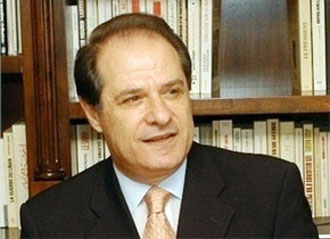
And here we are today facing an international/Iranian conflict on the land of Lebanon... 15/7/2021 Sajaan Azzi Former Minister @AzziSejean  (See Translation in Arabic Section) We cannot be dependent and demand that the world treat us as independent. We deplore the interference by countries in our crisis with the intent of addressing it but we do not deplore the intervention by other countries in igniting our crises. Were it not for the countries that invaded Lebanon, other would not have allowed themselves to deal with our affairs to save us. The former intervened against our will and the latter at our insistence. In Lebanon, whoever carries the axe to cut off any hand that extends assistance, as if the goal of these people is to kill Greater Lebanon, wants to transfer Lebanon from pluralism in unity to pluralism in unity. He who brings a guardianship from here must wait for a guardianship from there. This is the history of Lebanon ever since. People generally move in a cycle that rotates in different forms. This cycle does not stop until the people embark on a new path that will last for a fixed and successful time, enabling them to create a new cycle. We, in Lebanon, have been out of our historical cycle for an insufficient period (1943-1969) to create a new cycle so we stayed in the previous cycle as if the inevitability of history is stronger than self-determination. We rarely lived in complete independence despite our struggle for it. We spent our existence, before and during Greater Lebanon, between guardianship and occupation, between autonomy and relative independence. And if the occupations before the emergence of Greater Lebanon were the norm of those eras when there were no international borders or international laws yet, then the occupations that “honoured†us after independence did so at our request. We Lebanese tend to concede to the stranger instead of conceding one to another. This is a scourge caused by multiple loyalties. We still define other Lebanese based on his external loyalty and not based on his Lebanese affiliation, so we say: This is a Syrian, this is a Palestinian, this is an Iranian, this is a Saudi, this is an Egyptian, this is a French, and this is an American, and by chance we fall upon a Lebanese. If I am against any form of guardianship, whether it comes from the East or the West, there remains a difference between beneficial and harmful guardianship. The world knows commandments that brought stability, investment, urbanization, sophistication and civilization, and trained peoples to practice democracy. It also knows commandments that brought wars, isolation, decadence, backwardness and collapse and taught peoples to submit to dictatorship. The strange thing is that Lebanese groups deliberately consider assistance as guardianship, and do not find guardianship in the occupation. How can groups that blocked the people from internal salvation, slander their friends and criticize them when they come to their aid? By what right do these groups refrain from saving him and prevent his rescue? In the name of national dignity? What dignity when the people are hungry, poor, begging, humiliated and dying? What sovereignty when the homeland is kidnapped, confiscated, harassed and dismantled? The strangest thing is that these groups drop the Lebanese solution, the Arab solution, the French solution, and object to the international solution, which is the result of their tampering with Lebanon's existence. Nothing likes her so he is sure that she is carrying a project of a permanent crisis, not a project of a final solution. Most Lebanese would not welcome the international role if it did not feel that it is under Iranian tutelage with the grip of Hezbollah and its control over the state, and if this tutelage - regardless of whether we are with it or against it - did not lead to catastrophic results on the political, economic, economic and security levels: country collapse. Leave politics aside, numbers speak and facts. And here we are today facing an international/Iranian conflict on the land of Lebanon, the extent of which we do not know and how it will develop. Nothing has changed for us because we have not changed. We are still a people fighting as if we were 1000 peoples and 1000 tribes. We are united by the instinct of conflict and disagreement, not the nature of harmony and integration. All that we collected, rejoicing, in the vessel of unity scattered as soon as we hit a crisis that touches the fringes of a sect, a sect, or the idol of the masses. In less than24 hours, the old grudges that we thought were buried forever explode. We look at the state from a commercial view, from which we want to profit, not from a national view that consolidates it. Our divisions, combined with our performance, made the world treat us as a people incapable of managing its own affairs. This is evidenced by the nature of the international “mobility†towards Lebanon, which is like its movement in the nineteenth century: associations and embassies investigate and send their reports to their countries, France moves and is confronted by the Sublime Gate (currently Iran). Delegates come, ministers meet and form diplomatic committees to follow up. The Vatican intervenes with the decision-making countries to preserve Christians and partnership with Muslims. Nations organize economic conferences, prepare for political ones, etc... It is noteworthy that what the international community is proposing to the Lebanese in 2021 is an exact copy of what the European delegates proposed in 1850 (the Vienna Conference) and 1860 (the implementation of the Mutasarrifiya system): “Sending an international fact-finding mission, self-determination at that time (the achievement of Lebanon’s unity), the achievement of the unity of Lebanon’s interests at that time. Between the disputants, reforms in the ruling authority, the disarmament of all Lebanese groups, and the limitation of military power to state agencies. The same repetition also occurred at the Arab Summit Conference (Riyadh 1976) to stop the two-year war in Lebanon, as its decisions (stopping the war and sending Arab deterrent forces for a period of six months) were completely identical to the decisions of the Vienna Conference. The difference, however, is that the French forces that entered Mount Lebanon in 1860 adhered to the Vienna resolution and withdrew after 9 months after the cessation of hostilities, while the Syrian forces weakened the Arab deterrent forces and remained alone for thirty years, not six months... All of this means that: 1) the unitary and peaceful progress made by the Lebanese people over the past hundred years has not sufficed to establish an independent and stable Lebanese state capable of unifying its components and folding the pages of historical divisions. 2) Lebanese pluralism, in the absence of neutrality and unity of loyalty, is unable to withstand in a unitary central form in the face of the "federalization" of the region. 3) The declining civilized level in our societies has become below the level of Lebanon's message and Lebanon's message. 4) Lebanon needs, from time to time, to an international “re-charge†to maintain a minimum level of cohesion and stability; But for how long? |