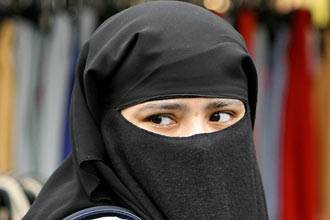
Decree aims at fighting extremism: official Face veil banned in Syria universities LONDON An earlier dismissal of fully veiled school teachers in Syria is now followed by another ministerial decree that bans niqab in university campuses on the grounds of fighting extremism and promoting moderation. Syrian Minister of Higher Education Ghiath Barakat issued a decree prohibiting female students wearing the face veil from entering university campuses, the on-line press agency Syria News reported Sunday. " The minister declared his objection to the face veil which, he argued, is against academic principles and campus regulations " Ministry of Higher Education official The decision, the minister said, was issued based on the requests of several parents who demanded that their girls be educated in a place that is devoid of any aspects of extremism. Concerns about the face veil were especially voiced in private universities. The increasing number of requests instigated presidents of universities to meet with the minister Wednesday and discuss the possibility of banning the niqab on campus, said a ministry official who spoke on condition of anonymity. "The minister declared his objection to the face veil which, he argued, is against academic principles and campus regulations," the official told Syria News. The minister, the official added, stressed that the ministry cannot allow students to fall prey to extremist ideologies. "The minister said that Syria has always been capable of warding off several attempts at implanting subversive thought in its society and has managed to conquer all those ideological invasions. He also called for raising awareness of these potential threats amongst youths." Kolona Shorakaa (We are all Partners) website, supervised by member of the ruling Baath Party Ayman Abdul-Nour, dealt with a matter in quite a cynical manner and claimed that the niqab ban was imposed by the National Security Bureau affiliated to the party. "Reliable sources have it the entire niqab issue, whether in schools or universities, has nothing to do with the requests of the parents," read the website. "Since when have the voice of people been heard?" According to the website, it is not the ministers who issue such decrees, but the National Security Bureau which instructs ministers to implement this decree in the institutions affiliated to their ministries. The Minister of Education dismissed in June around 1,200 school teachers wearing the face veil also on the grounds of fighting aspects of extremist behavior in society and promoting state secularism. In his statement about the ban, Minister of Education Ali Saad announced that the decision would shortly be applied to other ministries. (Translated from the Arabic by Sonia Farid). A burqa ban is likely in Spain MADRID (AP Spanish lawmakers will debate barring burqas in public, joining other European countries considering similar moves on the grounds that the body-covering garments are degrading to women, according to the leading opposition party. Top officials of the ruling Socialist Party have indicated they will support the proposal by the opposition Popular Party, making a ban likely unless the country's highest court rules it unconstitutional. A debate in Spain's lower house has been set by the Popular Party for Tuesday or Wednesday, the party said. No vote will be scheduled until after the debate, and Spain's Parliament usually goes on vacation for a month starting in late July or early August. Justice Minister Francisco Caamano said on June 15 that garments like the burqa are "hardly compatible with human dignity." Head-covering veils would not be included in a ban as they form apart of traditional Spanish dress, with women often covering their heads with a garment called a mantilla, especially during church services in the south of the country. Other European nations that have debated regulating the use of body-covering burqas or face-covering niqabs include Belgium, the Netherlands and France. France's lower house of parliament overwhelmingly approved a ban on wearing burqa-style Islamic veils on July 13 in an effort to define and protect French values, a move that angered many in the country's large Muslim community. The French ban on burqas and niqabs goes before Senate in September amid predictions it will pass, but its biggest hurdle could come when France's constitutional watchdog scrutinizes it later. Belgium's lower house approved a ban on face-covering veils, but it must still be ratified by its upper chamber. The Netherlands debated banning burqas four years ago and may yet outlaw attire that is considered as demeaning to women. Switzerland last year banned minarets from where Muslim are called to prayer following a national referendum last year. Spain has about 1 million Muslims in the nation of 47 million, with most living in the northeastern region of Catalonia and the southern region Andalucia. However, burqas are rarely seen. Spain's second-largest city of Barcelona in June banned the use of burqas and niqabs in municipal buildings, joining a handful of small towns and cities nearby that have taken similar steps. Mansur Escudero, spokesman for Spain's Islamic Commission, said in June that there is no religious mandate for Muslim women to wear burqas and the garment was "extravagant," but criticized government efforts to ban the outfit because he said women should be able to exercise free choice in how they dress. Burqa empowers women, says British minister (Agencies) 19 July 2010, As debate intensifies across Europe on banning the veil, a minister has defended a Muslim woman’s right to wear the burqa and says it is empowering. Environment Secretary Caroline Spelman said women were “empowered†by the freedom to wear the face coverings. Her comments came after her colleague, Immigration Minister Damian Green, resisted demands from within the Tory party to ban the burqa, according to Daily Mail. Green said a ban would be “rather un-British†and run contrary to the conventions of a “tolerant and mutually respectful societyâ€. This is despite a YouGov survey which found that 67 percent of voters wanted the wearing of full-face veils to be outlawed in Britain. France’s lower house of parliament has overwhelmingly approved a ban on wearing burqa, while Spain and Belgium have similar laws in the pipeline. Tory MPs supporting a ban include Philip Hollobone, who has tabled a private member’s Bill that would make it illegal for anyone to cover his or her face in public. Spelman, however, argued that wearing a burqa is important for women’s rights. “I don’t, living in this country as a woman, want to be told what I can and can’t wear. I’ve been out to Afghanistan and I think I understand much better as a result of actually visiting why a lot of Muslim women want to wear the burqa,†she said. “It is part of their culture, it is part of understanding that they choose to go out in the burqa and I think those that live in this country, if they choose to wear a burqa, should be free to do so. “We are a free country, we attach importance to people being free and for a woman it is empowering to be able to choose each morning when you wake up what you wear.†|