|
|
|
| “Genuine peace requires an end to attacks, Israel’s withdrawal, and full Lebanese state authority.” |
** Aoun Internationalises Lebanon’s Demands from the Vatican and Rome:
Ending Israeli Attacks and Securing Withdrawal Are Urgent Priorities’
|
“Genuine peace requires an end to attacks, Israel’s withdrawal, and full Lebanese state authority.”
Sydney-Middle East Times Int'l: In a significant diplomatic initiative carrying important political and national dimensions, President of the Republic General Joseph Aoun presented Lebanon’s most pressing concerns to the highest spiritual and political authorities in the Vatican and Rome.
The President sought to mobilise stronger international support to halt Israeli attacks, end the occupation and restore stability in southern Lebanon.
The visit came at a particularly critical time, as the south continues to endure persistent military tensions and growing fears that daily Israeli attacks could undermine efforts to consolidate calm and enable displaced residents to return to their villages.
It also coincided with preparations for the conclusion of the United Nations Interim Force in Lebanon’s mission, raising major security and military challenges concerning the Lebanese Army’s deployment and the restoration of full state authority in border areas.
Lebanon’s Message from the Heart of the Vatican
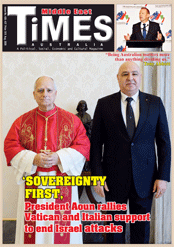
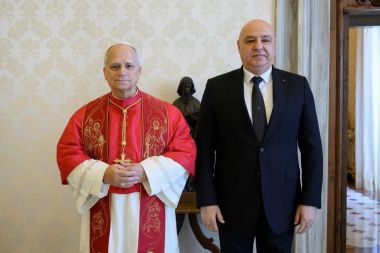
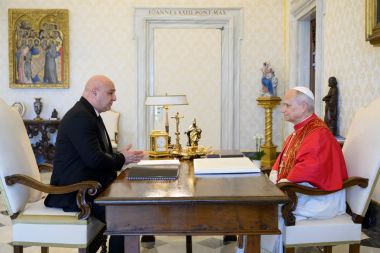
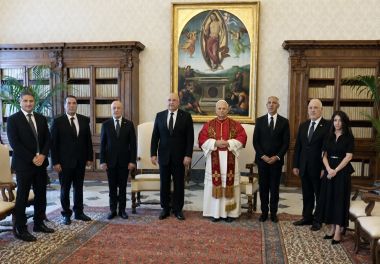
President Aoun began his visit with a meeting with Pope Leo XIV at the Apostolic Palace, where the two leaders held a private discussion lasting approximately 30 minutes.
Their talks focused on Lebanon’s political, security and economic situation, the dangerous developments in the south, and ways to support stability and protect civilians and vital infrastructure.
President Aoun arrived at the San Damaso Courtyard, where he was welcomed by the head of Vatican protocol, Monsignor Javier Fernández González, before being escorted by the Swiss Guard to the Pope’s office.
During the meeting, Aoun renewed Lebanon’s gratitude to the Pope and the Holy See for their continuing efforts to support the Lebanese people and defend their right to security, sovereignty and stability.
** ** ** He also called on the Vatican to maintain its diplomatic engagement in international forums to compel Israel to implement the provisions of the framework agreement reached under United States sponsorship on June 26.
The President stressed the urgent need for an immediate end to Israeli attacks targeting civilians, villages, civilian facilities and infrastructure across southern Lebanon. He also called for serious international pressure to secure Israel’s complete withdrawal from occupied Lebanese territory.
Aoun said such a withdrawal was essential to launching the reconstruction of areas destroyed by Israel, facilitating the return of displaced residents to their homes and villages, and restoring normal life to border communities that have paid a heavy price for the continuing violence.
In a gesture carrying profound national and spiritual significance, President Aoun presented the Pope with a bust of Blessed Patriarch Elias El-Hoyek containing relics of the beatified patriarch, whose name is closely associated with the establishment of Greater Lebanon and the defence of the country’s independence and sovereignty.
Supporting Sovereignty and the State’s Exclusive Authority over War and Peace
President Aoun’s message at the Vatican was not limited to demanding an end to Israeli attacks. It was accompanied by a clear affirmation of the Lebanese state’s commitment to extending its authority across the entire country.
The President stressed that protecting Lebanon and achieving lasting stability along its borders require that decisions of war and peace remain exclusively in the hands of the state and its legitimate institutions.
He described this course as the only path towards building a strong and just state capable of protecting all Lebanese citizens and safeguarding the country’s sovereignty.
Aoun therefore presented the Vatican with an integrated approach based on two inseparable tracks: compelling Israel to end its attacks and withdraw from occupied territory, while strengthening the authority of the Lebanese state and the role of the army and other legitimate institutions.
Following his meeting with the Pope, President Aoun held talks with Vatican Secretary of State Cardinal Pietro Parolin and Secretary for Relations with States Archbishop Paul Richard Gallagher.
He briefed them on the latest developments in Lebanon, particularly Israeli violations and their humanitarian, security and economic consequences.
Vatican Concern over Difficulties Implementing the Agreement
In a position reflecting the Holy See’s close attention to developments in Lebanon, the Vatican expressed its “deep concern” over the difficulties obstructing implementation of the framework agreement between Lebanon and Israel.
A Vatican statement said the Holy See, which had welcomed the signing of the document, supported continuing efforts to implement it and pave the way for de-escalation, security and stability.
This position is particularly important because of the Vatican’s diplomatic and moral influence and its ability to convey Lebanon’s concerns to international decision-making capitals and global public opinion—particularly regarding the protection of civilians and opposition to continuing occupation and attacks.
From the Vatican to Rome
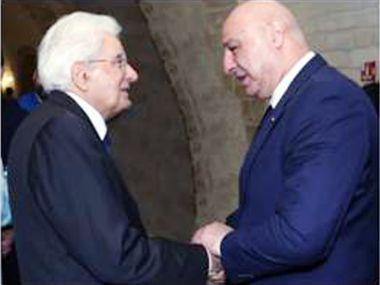
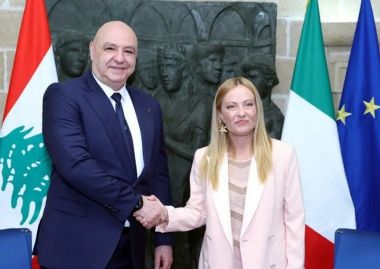
Following his Vatican meetings, President Aoun travelled to Rome, where he met Italian President Sergio Mattarella and Prime Minister Giorgia Meloni, continuing his efforts to mobilise European support for Lebanon’s demands.
During his meeting with Meloni, Aoun discussed Lebanese–Italian relations and ways to strengthen cooperation in various fields.
He thanked Italy for its continuing political, security and humanitarian support for Lebanon, as well as its significant contribution to the international peacekeeping force in the south.
The talks addressed the continuing Israeli attacks and the need to pressure Israel to comply with the framework agreement reached during Lebanese–American–Israeli negotiations in Washington.
Aoun also thanked the Italian Prime Minister for her country’s hosting of trilateral negotiations and for Italy’s role in promoting security and stability in southern Lebanon.
The future of the south following the conclusion of UNIFIL’s mission featured prominently in the discussions, given Italy’s important role within the international force and the need to prevent any security vacuum.
During his meeting with President Mattarella, Aoun discussed the historic bilateral relationship between Lebanon and Italy, as well as developments in Lebanon and the broader region.
He emphasised the importance of maintaining cooperation between Beirut and Rome in the political, economic and security fields.
Lebanon’s Ambassador to Italy, Carla Jazzar, attended both meetings.
Lebanese Army Takes Over UNIFIL Positions
As President Aoun held talks in Rome, the first practical signs of the post-UNIFIL phase began emerging on the ground.
The international force handed over its position near the Lebanese Army’s base in the Khardali–Litani area to the army’s Seventh Brigade.
The handover forms part of a plan to transfer several positions previously operated by UNIFIL to the Lebanese Army, following the United Nations Security Council’s decision to end the international force’s mission at the end of the year.
This transition represents an important test of Lebanon’s ability to fill the emerging security gap and strengthen the state’s presence in the south.
Its success, however, remains dependent on securing the necessary international support for the Lebanese Army, ending Israeli attacks and achieving Israel’s withdrawal from the points and territories it continues to occupy.
Diplomacy to Restore Sovereignty and Stability
President Aoun’s visit to the Vatican and Rome reflected a clear Lebanese effort to move the country’s case beyond conventional statements and diplomatic positions towards an international initiative capable of generating genuine pressure.
The visit brought together the Vatican’s spiritual and moral influence and Italy’s political and European weight, presenting both sides with a Lebanese roadmap based on ending the attacks, securing Israeli withdrawal, beginning reconstruction, facilitating the return of displaced residents, strengthening the army’s deployment and placing decisions of war and peace exclusively in the hands of the state.
With tensions continuing in the south and the international peacekeeping mission approaching its conclusion, the coming months are likely to prove decisive for Lebanon.
Diplomatic efforts must either succeed in transforming commitments and agreements into practical steps, or the south will remain trapped between daily attacks and the danger of an open-ended escalation.
From the Vatican to Italy’s presidential palace and government headquarters in Rome, President Aoun raised Lebanon’s voice and called on the international community to fulfil its responsibilities.
His message was clear: sovereignty cannot be complete without the liberation of occupied territory, and stability cannot be achieved without a state capable of extending its authority across the entire country and protecting its people through a unified national decision. |
|
|
|
|
|





 (2).jpg)